A TECHNIQUE DRIVEN Blog dedicated to mastery of surface design techniques. First we dye, overdye, paint, stitch, resist, tie, fold, silk screen, stamp, thermofax, batik, bejewel, stretch, shrink, sprinkle, Smooch, fuse, slice, dice, AND then we set it on fire using a variety of heat tools.

Showing posts with label Fugitive Media. Show all posts

Thursday, October 6, 2011

My last fugitive media piece


Hi there, Kit Lang here.  When I left you last, I had used watercolour pencil-crayons, watercolour crayons and a little charocal on my flower.  After it dried and I had ironed it to set the colours, I cut out the petals and fused it to a background composed of two pieces of my hand-dyed fabric.


I also used a micron pen to write the script on the right. 

I'm really pleased with this first experiment using fugitive media, and it will be something I develop for use again and again.

Further explication of the piece and what the writing is at my blog.

Sunday, October 2, 2011

Better Late Than Never--Fugitive Media

I FINALLY got to play with my colored pencils and chalk pastels today. I had intended to do it last month (since this was last month's technique), but...life stepped in! I must say, I like the effect. This is the original fabric--a piece I had snow dyed this past winter.
This piece always reminded me of the geyser pools I had seen when we went to Yellowstone several years ago. My favorite was Morning Glory. The colors in this piece were wrong for that, but I used pictures of Morning Glory for inspiration. I wanted to define the outer circular shape a bit more and emphasize what looked to me (and to Judith when I got to meet her in Indy this past week) like bubbles.
(The difference is way more subtle in the pictures than it is in person.) I used the chalk pastels to emphasize the edge of the "pool" and add some shadows around the "bubble" areas. Hopefully, it gives it a bit more dimension. I used a little colored pencil too, but that barely shows up on this piece.
 Close Up of Fugitive Medium on Snow-Dyed Fabric

I now can visualize how I will hand quilt this piece (if time permits)...organic lines out from the edge of the pool and lots of circles for the bubbles within the pool. I even found some silver embroidery floss that I might use to give it a bit of shine--like a reflection. I might also add a little shine with a bit of metallic paint.

Thanks Judith for sharing this new technique...now on to "setting things on fire!"

Friday, September 30, 2011

One last post about Fugitive Media

I have really enjoyed this month of working with fugitive media.  I have tried lots of different media and have only scratched the surface of the possibilities!  I might even get really brave and use the media to not only enhance a dyed fabric but to draw something like Karen did with her heron.  Here is the heron appliqued  onto her quilt. Stunning is the word I would use for it. If you are also thinking about using fugitive media to create your own drawings, here is one last suggestion for you.

Here is a free ebook offered by Interweave on Pastel Painting.  The techniques and processes he describes can be used on fabric!   While he is using pastels, the color theory and layering he describes could be used with water-soluable pencils or crayons too I think.   Just remember:
  1. The pastels must be chalk or water-soluble.  Regular pastels have an oil base that will repel the bonding liquid.  If you use a regular pastel, it will wash out.
  2. Take care with the layering that it is not so heavy as to block the bonding liquid from actually wetting the fabric. That is needed for the bonding to occur.  It is possible to wet with the bonding liquid after each layer, let dry, and then add the next color layer if  needed.
  3. Use a bonding fluid such as base extender, 50/50 glue and water, acrylic media, etc.
  4. IRON it to heat set it.

Thursday, September 29, 2011

Fugitive Medium plus Wen's Workshop

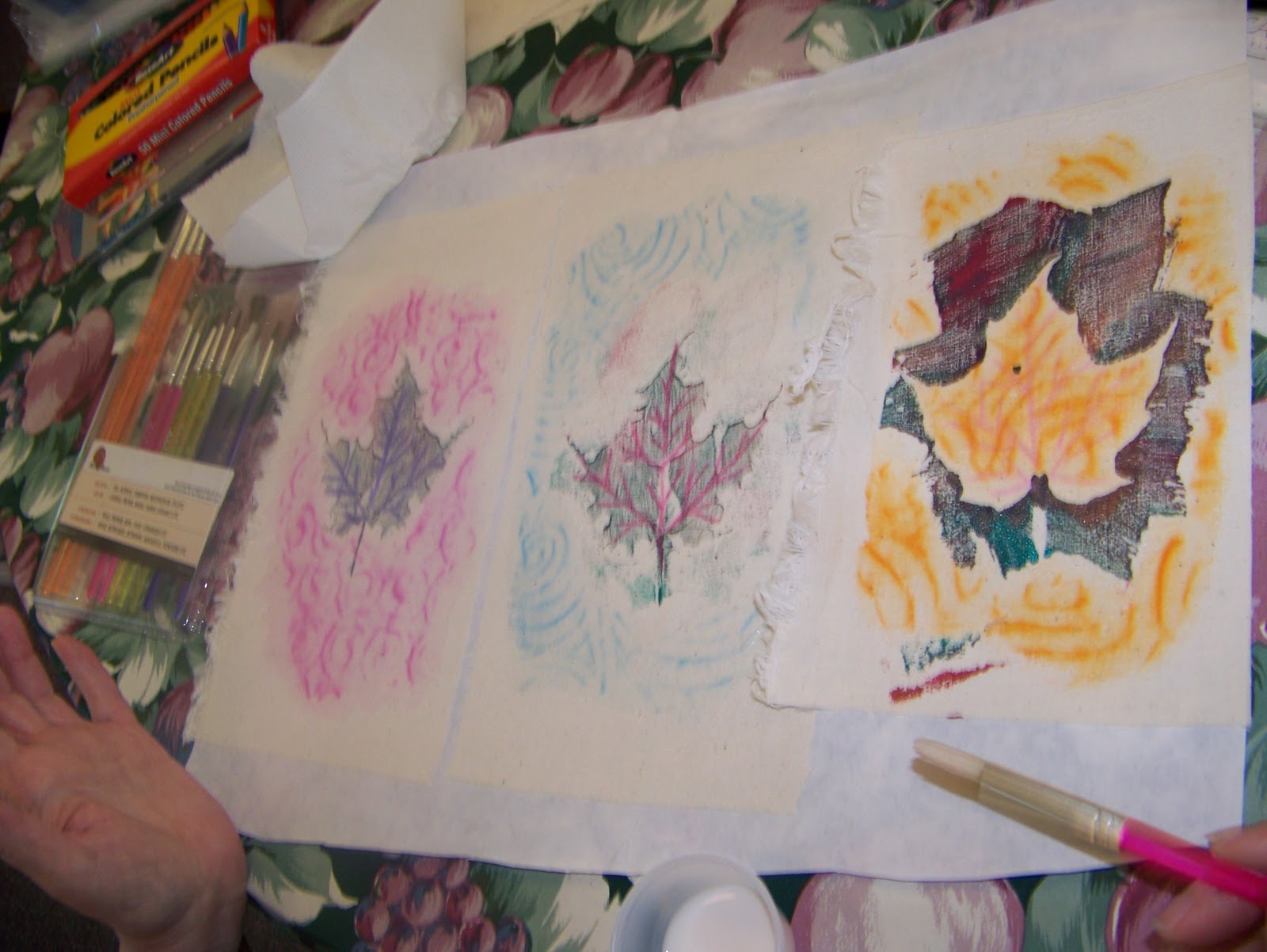
I promised you more pictures from the SAQA Maine Event that included prints made during Wen's workshop in the morning and then enhanced in my fugitive media workshop in the afternoon.  Here they are.

 That's Wen.


Wednesday, September 28, 2011

A Fugitive Medium Experiment

Today I am being an artist/scientist and experimenting.  I have two pieces of fabric that I ice-dyed at the same time.  The two fabrics looked very floral to me so I decided to enhance that fabric story.  I then drew petal shapes around dye blobs on both fabrics with a micron pen. So far, I have treated them the same.

For my independent variable (or is it dependent variable?  I get confused) I used two different fugitive media.  For one I use water-color pencils--not inktense--and for the second I used chalk pastels.

 I took the two samples around to everyone in my office for their opinions about which turned out better and why.  Very interesting results.  So, which do you like better?  I am not telling you which one is the pencil and which one is the chalk till I get some input from y'all.  So, with some pictures closer than other and in no particular order--

One

Two

Three

Four
Five
Six

Monday, September 26, 2011

Fugitive Media - watercolour pencils and crayons

Kit here.

I tried the fugitive media this weekend using watercolour pencils and watercolour crayons. 


I started out with a piece of my hand-dyed fabric (from when I was attempting make mandelas with procion MX dyes),


and with a watercolour pencil, I enhanced the fuschia lines that were already dyed in, and added blue at the ends of what I imagined were petals. 


Also with watercolour pencils, I added some green. I just left it in the "lined" state as I knew once I added some water, I would be blending. I used a flat, square paint brush with hard rather than soft bristles for the blending.


Then, I used my watercolour crayon to add some more depth to the petals.  (I was working outside in the garden, so as the sun moved around it created shadows on my work.)


After that, I used a charcoal pencil, made "feathered" edges at the ends of the petals. Then I used my paintbrush dipped in water to blend the colours I'd added in.  In retrospect, I'd do the charcoal step at the end, when my petals were done, rather before;


because after I drew in the petals with the watercolour crayons, I had this odd circle shape.  Lesson learned!


I then painted on a mixture of half and half base extender and water, and let it dry. And now all that's left with this is to decide what to do with it.

I've also bought some pastels and will be trying that next.  I'll post about it in a couple of days.

Cheers,


Friday, September 23, 2011

Fugitive Media

Finally, I've had some time to try out this technique! I used some regular pastels on white fabric, just drawing some flowers out in various colors. Then I painted the whole piece a very light lavender using Pebeo Setacolor paint, covered it with textile medium using a screen, and quilted some outlines in black. Here's a picture from late last night when I finally had to put it away and go to bed:

More flowers. It was a lot easier to draw the flowers out first, then sew around them. The textile medium I used seemed to create almost a laminate type of fabric. Definitely gave my sewing machine needle a workout--I want to wash the piece to see if it softens up a bit.

And here's another piece I painted some flowers on with setacolors in pink & yellow, then drew the leaves in with pastels. I learned that the setacolors are pretty transparent and the pastels aren't, as you can see in the leaf on the right side.


I took the textile medium and applied only to the green parts with a brush, then heat set the piece with my iron and threw it all in the washing machine. No fading or anything following the wash.


Finally, this last piece was from the challenge we had recently--there was too much white on it when I got it back, so I decided to color in the white lines with a blue pastel crayon. It actually looks purple in this picture, which makes me thing I might want to color it over in purple.


I screened the textile medium on this, too, and washed it, but it still feels kind of stiff. I just got a cheap medium at Joann's or Michael's, if someone is using a better one that doesn't stiffen up the fabric, could you tell me which one I should try?

Monday, September 19, 2011

Fugitive Medium at the 2nd Annual Northern New England SAQA Weekend

How about that for a title?  I chose fugitive medium this month knowing that I was going to be teaching a workshop at the SAQA Weekend.  I basically showed some examples of chalk, charcoal, cretacolor aqua bricks, watercolor pencils, inktense pencils, water-soluable crayons (did I miss something??) art work on fabric and told the participants to go to it.  And they did!  Here are some examples of their work.


 The workshop before mine was presented by Wen Redmond and was Tracking the Wild Print.  She showed how to use plants to create a direct, shadow, and ghost prints.  Those prints made fabulous first layers for enhancement with fugitive medium.  More pictures later showing that wonderful collaboration.

Wednesday, September 14, 2011

Throw 'em in leg irons so they won't escape!

It occurred to me last night as I was trying to go to sleep that I have not stressed the importance of heat-setting the fugitive media after you coat it with the base extender.  IRON IT!  Until it is captured by the iron, the media can still escape your clutches!

Tuesday, September 13, 2011

Chalk as a Fugitive Media

Chalk is one of my favorite fugitive mediums.  First because it has more control than many of the other mediums.  Second, it is inexpensive.  I picked up this box of 48 chalk pastels for around $5 at A.C. Moore.  So, let me show you what it can do.

This is a ice dye fabric I made last weekend in a play date with the FIVE.  It is looking like flowers to me and I want to enhance that.
I am using this shirt of mine as a model.  I like the way the  petals are defined and want to try and attempt the same type of affect on the ice dyed fabric.
I used a micron pen to outline some petals.  I just kinda drew around shapes in the dye.  No formula or pattern here.  Then came the fun part. 
I started by drawing straight onto the dry fabric with pastels.  I didn't add color to every petal but only to those that fit into an entire flower unit.  The chalk is subtle so it does not block out the background colors but does add to it to make the flower more cohesive.  On the flower on the bottom right I added purple.  The one of the bottom left I added white--the purple was already there. The top left flower I added a light blue chalk.  Top right I added orange and yellow-orange.  I rubbed the chalk lines with my finger after I drew with the chalk to help them blend in.  I could have chosen to leave the chalk lines more distinct if I wanted.

Once I had the amount of color I wanted, I painted the chalk flowers with a 50/50 mix of water/base extender.  I used a small paint brush because I didn't need to paint the entire fabric--only the part that I added color with the chalk. Here is where the control comes into play that I had talked about before.  With colored pencils or crayons, the colors will blend and bleed. The chalk doesn't.  You do the blending with your finger while it is dry.  When you paint it with the 50/50 mixture, it does not run.  Yeah!

Once the flowers were wet, I decided the bottom right flower needed a bit more color so I added the pink.  The bottom left flower needed some more white so I added it too.  You can tell because the lines are a bit more distinct on the wet fabric than when I added chalk to the dry fabric.  I am quite pleased with the results.

Monday, September 12, 2011

An old post and a new one

Here is a link to a post that Laura already posted about using inktense pencils.  I love her work and think her post along with the post from Rosalita do a good job of showing you the possibility of colored pencils.  In my own experiments with colored pencils I used both inktense and regular water-soluble pencils.
Frankly the only difference  I have noticed in the two types of pencils is that the inktense pencils only blend the first time they get wet.  Regular water-soluble pencils will bleed/blend each time they get wet.  I will use both types on a fabric because the colors are different and it expands my possibilities.

Thursday, September 8, 2011

Good News, Good News, and MORE Good News!

I have some 3 good newses to share!

First, Karen Silvers is joining our group of resident artists!  She has already guest starred on the blog and now she is becoming a regular member artist.  Here is an introduction of her on the Art Quilt blog.   And here is the link to her personal blog.  We are so excited she has decided to join us!  Please give her a warm welcome.

Second,  Rosalita Feero, who has been so busy making and selling her art that she has not been able to participate regularly, is going to be a guest blogger sharing how to use inktense pencils on fabric.  You'll understand when you see her work  why I asked her to share with you.  Her use of the pencils to create stunning quilts just is unmatched.

And my last wonderful news is that Kathy Molatch, who has also become so busy with her own career that she is unable to participate regularly on the blog, is going to share the results of the Round Robin held by the FIVE.  Please pay special attention to the crane fabric.  While each of the FIVE did something to the fabric, I added the charcoal-edged sun and rays to the dyed fabric.  Do you like the effect it gives?   It is another example of the fugitive media, charcoal, being used on fabric.

Friday, September 2, 2011

September's Technique--Fugitive Media

First let me start with an apology!  I have been dieting.  You would think that is a no brainer but it takes lots of thought and work on my part.  Consequently I have been missing the rest of my life for the last couple of months. I am being successful--lost 22 lbs so far--but I am needing some more balance (i.e. ART) in my life and am determined to work on it this month. Thank you for understanding or at least not throwing rotten vegetables in my direction.

Okay, this weekend I will post more information about the technique but let me here post a supply list of things you will want for our play this month.

·         Pre washed and Ironed Fabric:  Fat quarters or smaller lengths of cotton, cotton/poly blend, polyester or any other fabric that can be ironed with a hot iron.  Try one plain piece and then some fabrics that needs a second or third technique.  You could even try some commercially printed fabric that needs some help.
·         
      Fugitive Media:  Generally this is any water-soluble media that was intended for paper but we will be using them on fabric.  Items such as charcoal, conte, chalk, graphite, and water soluble pastels, crayons, and pencils.  (Laura, here is your chance to get your ink tense pencils back out!)

·         Transparent Base Extender:  Fugitive media is called that because it will wash out unless bonded to the fabric.  You can use a base extender (I like Pro Chem’s the best), clear acrylic medium, or 50/50 Elmer’s glue and water.   The cheaper ones--like the 50/50 Elmer's glue-- will stiffen the fabric but then we aren't making baby quilts.  I would certainly start there before buying the more expensive base extender if you don't already have it.

·         A stiff surface:  Either use a foam core board and pins or tape to secure your fabric OR  some freezer paper to iron to the back of your fabric.  Fabric that is secured one way or the other will be easier to work with.  I have done it both ways depending on what I was making.

·         Odds and Ends: We are playing so you will want: some brushes (a variety of sizes), plastic spreaders or squeegees, a container for water.  You may also want some rubbing plates and a silk screen and its equipment but they are not necessary.  
       
      So, start gathering and I will post more information and some pictures of things I have made using this technique. Till then I have enclose a link to the Quilting Arts show that Kerr Grabowski demonstrated the technique and here is her PDF handout.