A TECHNIQUE DRIVEN Blog dedicated to mastery of surface design techniques. First we dye, overdye, paint, stitch, resist, tie, fold, silk screen, stamp, thermofax, batik, bejewel, stretch, shrink, sprinkle, Smooch, fuse, slice, dice, AND then we set it on fire using a variety of heat tools.

Showing posts with label November 2011 technique. Show all posts

Thursday, December 1, 2011

Last one....


As some of you may know, I've been having computer problems (it's still living with The Geek Squad), so I've had virtually no computer access as work doesn't allow most entertaining type sites.

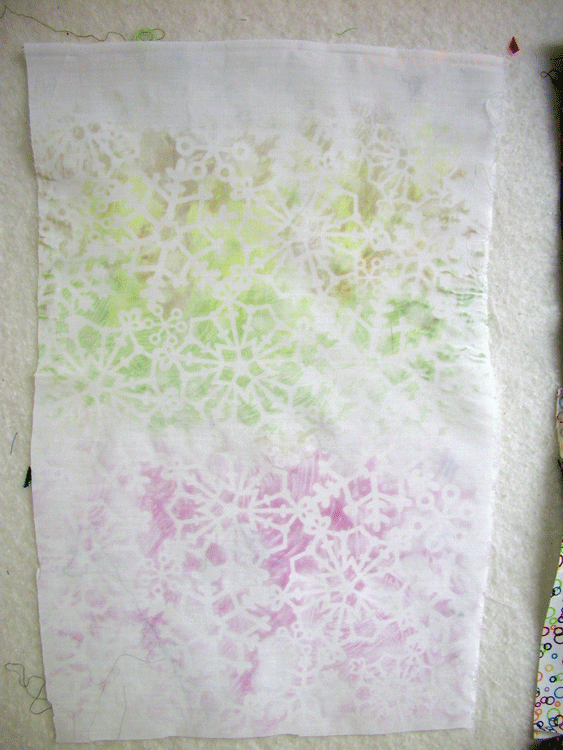
But I managed to do this: show the last thing I made with transfer paints/disperse dyes in this sad little un-retouched photo taken in bad lighting on a rainy day with my phone!

Later, when I have access to both my computer and the pictures on it, I'll edit this post with a better pic, but for this one, I cut out the shapes on my papers and ironed away - and got some great effects which are not necessarily apparent on this photo.

So, learnings:

1.  Unlike some of the others, I didn't use kits, nor did I use transperse paints.  I used transFER paints pre-mixed and disperse dyes that I mixed myself to the following recipe:

 tsp for a pale value
2 tsps for a medium value
4 tsps for a dark value; and
8 tsps for black

mixing the dye with 1/2 cup boiling water and a drop or two of synthrapol.  For watercolour effects on paper, thinning with another 1/2 cup of water

These gave great, results time after time, with no smell and virtually no mess. What mess there was, was easily cleaned up.
2. Using these mixtures and the pre-mixed transfer paints, I had the best results, by far, using art paper rather than bond (photocopy) paper

3.  The higher the value of man-made material in the cloth, the better the result was, with 100% polyester "silk" turning out the best result

4. A very sheer polyester tulle had great results with printing on both sides showing through

5.  These mixtures can also be mixed with thickener paste thinly mixed for paper, or using a thicker paste for printing, stamping or stencilling on paper very well.

6. Cutting out shapes and/or using resists gives really lovely results as well.

Overall, this is a technique that I will use again - there are some results I got that I have been unable to get with any other technique. If I were making a bed quilt, I would be hesitant about using this technique as there is some prejudice about using polyester/man made fabric in bed quilts  - but for art pieces, I have no compunction using it. 

I was pleased with both the learning curve for this technique (my first days with it were sad and pitiful!) and the results I got, as well as what I learned.

Don't forget, if you try this technique - come back and tell us!

Sunday, November 20, 2011

Transfer Paints - First Try - Karen


I finally mixed them up and tried them.  The first two photos are the results on some sheer poly stuff.  One is from the "fancy" section of the fabric store and the other is leftover from Halloween.


The fabrics are really sheer (you can see threads stuck to my design wall showing through).  I think this would be fun used as a technique to put color on some kind of an overlay -- it's very subtle.  I plan to experiment a bit more with these.

 This was the poly satin from the "fancy" department -- all this fabric was on sale and not terribly expensive.  I took a cue from the comments on the previous posts and placed a piece of laser cut paper from the scrapbooking department over the painted paper as a stencil.  The color is slightly darker than it looks on my monitor.
And this was my favorite.  I did it in two sections, using two different painted sheets.  The fabric is a 70/30 poly cotton blend and gave me the best color -- although I may have just gotten the hang of it as this was the last one I did.  I really like the color showing through the stencil.

I have to admit, I was dismayed when I mixed up the colors -- the yellow looked kind of brownish and the blue looked purple.  When I mixed the two, the color was muddy.  I was pleasantly surprised at the change in color on the fabric.  I have a bunch more paper painted up, so I'll be playing with it a bit more before I'm finished.  I'm thinking of painting an image, then trying to transfer it.  

Thursday, November 17, 2011

Experiments continued...


I have been working on other experiments over the past couple of weeks with transfer paints/disperse dyes.  For this piece (36 x 24 or so), I couldn't pick up the gloriously glossy effect that this fabric has as I'm not yet that skilled a photographer - but it's really lovely. 
For this piece I tore the painted papers into pieces and then laid a piece down, ironed it, laid another piece on top, ironed it  -  with a fairly light hand onto the fabric, a quite laborious proces, but a result I was quite pleased with. 

Monday, November 7, 2011

Wednesday, November 2, 2011

Where to buy:

Beth Berman kindly provided us with an option of where to buy the paint materials:


I'm sure it's not the only place in the US to buy them, (and this is in now way an endorsement)  but it's a good start!

Tuesday, November 1, 2011

November Technique

For November's technique, we're going to be working with transfer paints/disperse dyes.

The materials you'll need are:

transfer paints (I'm using G&S Dyes) and/or powdered disperse dyes (I'm using iDye Poly)
good quality paper
a variety of brushes/sponge brushes
Man made fabric that is at least 60% non-natural materials
an iron (preferably without steam holes)
a variety of resists - whatever floats your boat

I can't give you advice on where to purchase, because I live in Canada and my sources will be different than most of the readers on this blog.

Here are some examples of what can be done with this technique:


Gurli Gregersen produced this whole cloth quilt by using the transfer print method, which augmented with paint sticks and fugitive media.


"Loli Girl" at the Quilting Arts website produced the rocks in this piece by using powdered disperse dyes on interfacing.


And Marie-Therese Wisniowski produced this example using resists and disperse dye.

I'll give you a few days to gather materials and then we'll begin.

P.S. I was editing my first post and managed to delete it - my apologies to the two of you who had already responded!

Tuesday, January 11, 2011

Disperse Dye/Transfer Paints

Hi all,

For our November technique, we're going to be working with transfer paints (aka disperse dyes). 

Materials required:

good quality paper
disperse dye (powder form) and/or transfer paints (liquid form)
brushes and sponges for application
fabric that is at least 60% polyester
a variety of resists (whatever floats your boat)

This is a method in which you paint paper with either disperse power dyes, or liquid transfer paint, and then iron your design onto fabric.  A variety of techniques will produce varying results - and we'll go through some of them.

Here are some examples:


"Loli Girl" at the Quilting Arts website made these rocks by using the disperse dye method on interfacing


Gurli Gregersen made this whole cloth quilt using a transfer print, which she then embellished with paint sticks and other media.


Marie-Therese Wisniowski used the technique with resists to produce this lovely example.
I'll give you a couple of days to gather supplies and we'll talk soon!