A TECHNIQUE DRIVEN Blog dedicated to mastery of surface design techniques. First we dye, overdye, paint, stitch, resist, tie, fold, silk screen, stamp, thermofax, batik, bejewel, stretch, shrink, sprinkle, Smooch, fuse, slice, dice, AND then we set it on fire using a variety of heat tools.

Showing posts with label hand embroidery. Show all posts

Wednesday, July 6, 2016

Embroidered flowers

I picked up a book called The Art of Embroidered Flowers from the "free" table at my quilt guild meeting a couple of months ago.


It was written by Gilda Baron, who I googled and found out she had recently died.  There are several YouTube videos out there that she had done, showing demonstrations of her techniques, and this book is wonderful.  I'm sure most of you already have all the materials necessary to try some of these techniques.

I had already painted some pieces a few years ago using an assortment of Dynaflow and Jacquard fabric paints, so I dug them out and finally put them to use for this project:


First I drew some lines using fabric markers:


And of course heat set with an iron.


For a backing, the book recommended just using batting (wadding) but I have found it not to be stiff enough in the past, so I used some pretty heavy pellon interfacing.  I didn't use a hoop, but some people feel more comfortable using one, it's really not necessary if your stabilizer is sturdy.  

Then I started free motion stitching some lines to suggest grasses using an assortment of threads (rayon, cotton, polyester):


For the blue background, I painted some bubble wrap with purple paint then pressed it onto the fabric, then stitched some vertical lines: 


And finished them both off with some simple hand stitching, mostly french knots and flowers.
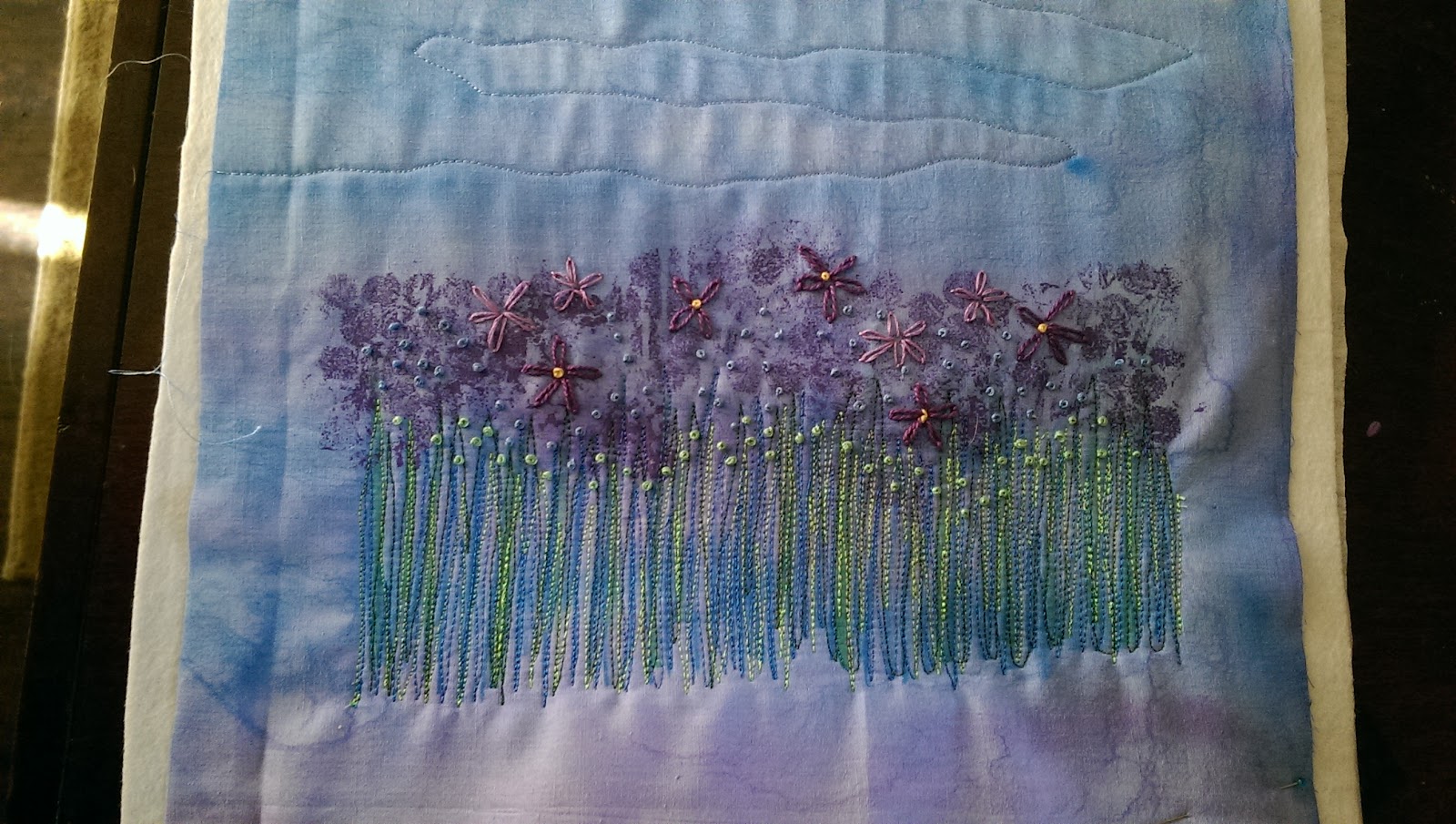


There was some minor puckering on these, so I asked my friend Jenny Williams (an extraordinary thread sketcher) what I could use for backing to eliminate some of that problem.  She suggested regular cotton duck, so I tried that for my next ones.  It was a lot easier to do hand stitching through than trying to get a needle through the pellon.

Also, if you're doing a lot of lines, it's smarter to add some zigzag stitches in first, as they fill up the background a whole lot faster than straight lines do.

Here are two more simple techniques from the book, using a zigzag stitch to suggest a flower like delphiniums or larkspur:


And cutting out  some little circles, which I glued to the piece before stitching--


Then took to my machine and made a quick series of zigzags which I later clipped--


With some french knots added:


And I tried out a different stitch for foliage here:


Just need to add a few french knots--


Next time I'll show you an easy way to finish them for framing.


Wednesday, April 27, 2016

The Real Thing


Have you ever used the actual plant in your artwork? Although dried plants may not be archival into the next century, there are times when I have used them as records, souvenirs, and art objects.
Years ago, I used my plant press to dry and store ferns, flowers, and leaves for my framed plant and paper collages that I sold at art fairs and from my studio. I see them occasionally in friends’ homes and I kept a few for myself, so I have kept track of their aging processes. The news is good – all have fared well, usually changing over time from their fresh green colors to rich golds and browns. I always posted information on the backs of the framed pieces to the effect that the dried plant material could be expected to transform beautifully.

Fern collage 12+ years after framing
In some cases, I used plants as evidence of place. A few years ago, I was in a group of several professional artists who worked with students at Paul Smiths College in the Adirondack Mountains to combine science and art for an exhibition called “Emerging Patterns.” The project examined forest succession and the related ecological processes. One artist collected lichens, bark, and other forest materials to dye fibers that became her weavings. Another artist created paintings while sitting at the site. My own group of five works developed from a poem the course professor wrote about his sense of the site. I included the five part poem printed on sheer organza, my own site photographs on thin layers of molding paste imprinted with balsam fir and birch twigs, maps of the area, scientific articles written about past research there, and  dry American beech leaves collected from the site and encased in sheer organza. The leaves related to a section of the poem as well as to one of the dominant trees.


One winter while staying in Florida with my mom, I was participating in an online daily creative practice. Each day when I walked in local parks or on the beach, I collected leaves, small plants, and feathers that I embroidered onto my sketchbook pages. I identified each species and painted the backgrounds with watercolor. The 8 or so pages made a nice group that I framed informally together.
 
 
These little pieces have held up very well, and now I have a record of my trip. I plan to frame them individually for my gallery.

Friday, June 5, 2015

Ta Dah!


So if you saw Wednesday's post, you know that I had a bag of about 30 tiny fabric collages to work on in the car. Was hand embroidery really going to do much for them? I just started in without overthinking , and soon I was loving the challenge of figuring out the right colors and combinations of stitches to make each little rectangle really pop.


 I finished embroidering all of them before our trip was half finished and started finding other things to embroider.  I was addicted by then!

The last section of my trip was the SAQA conference in Arlington, VA and I needed lots of business cards. Complications with internet service as we traveled prevented me from getting cards made via an online service. Instead I made a digital collage of the images of 2 dozen of the little collages I had made, printed them at a Kinko's, and cut them up. Fun cards - 24 different designs.


When I finally returned to my studio, I edge stitched each piece then satin stitched over that. The final step to prepare them for the art vending machine was to glue a piece of mat board with my personal information on it to the back of each tiny collage. I kept a few of my favorites and sent off the rest to be included in the vending machine at its 2014 summer home at the Wild Center in nearby Tupper Lake. Here are some of the completed collages.

Well, that's my story of the tiny collages for the art vending machine. But it's just the beginning of what I did with the pieces I kept and the collages that resulted. As the month proceeds, I'll have more posts about techniques, materials, and processes with fabric collage.

Posted by Cris Winters