A TECHNIQUE DRIVEN Blog dedicated to mastery of surface design techniques. First we dye, overdye, paint, stitch, resist, tie, fold, silk screen, stamp, thermofax, batik, bejewel, stretch, shrink, sprinkle, Smooch, fuse, slice, dice, AND then we set it on fire using a variety of heat tools.

Showing posts with label Colouring on Lutradur. Show all posts

Sunday, May 25, 2014

Printing on Lutradur...


Printing.... 

Wow what a month this has been .... I have had so much planned for you and I am only on printing.... 

Well here goes! 

Running Lutradur straight through an Ink Jet Printer.


Lutradur goes through your home printer like a dream. I have done it with sheets purchased and with cutting my own sheets from the yardage. 

An old picture from our families albums printed onto Lutradur...


 This picture was of a ship that was in Toronto Harbour, Ontario Canada in around 1905. It was a replica of Christoper Coloumbus Ship according to the caption. I printed it onto Lutrudur and mistakenly ran it through the printer twice but the print was interrupted. It shows how you can get a darker image on your print by running the piece through twice. 


In order to insure a good crisp print that lasts you have to treat the Lutradur. You can do this several ways.  

Note: Bubble Jet set and Pym II will not change the hand or fiber look of the Lutradur but  Matte Medium and Gesso will.

You can use Bubble Jet Set like you would with fabric. The Bubble Jet Set will help keep the colour to fade. See Carol Bryer Fallart-Gentry website for tips on how to use this product. 

 You can also go to the manufacturers’ website.  C Jenkins Company Note: I was thrown off when I went to this link because the Jenkins seem to be operating a restaurant as well now so they have their business on the same web page but there is still lots of good info if you go to the left hand side of the web page. 

You may also spray with a protectorant  Pym II (Preserve Your Memories) (see book for details) to keep the colour from fading. Or as a alternative you can use a product from Krylon which I have which sayes it is a UV protectorant.
 

 In turn you may use a soft gel matte medium painted onto the surface of the lutradur and then left to dry. The matte medium can be also applied after printing to protect the surface. The matte medium will decrease the amount of transparency of the Lutradur. I have used Golden Matte Medium 


Painting a layer of Gesso on the lutradur before running it through the printer (and letting it dry thoroughly) will provide a different look for the print. The Gesso will allow for a different texture for you print.

Leslie's Tip
lesleyriley.com

Jo:  I really seem to enjoy printing with my printer on Lutradur. I have tried both putting a matte medium on and bubble jet set. Since I am new to this is there any one way that the printing is more stable… longer lasting colour then another?

Leslie:  In this case, it’s not the Bubble Jet or the Matte Medium that matters, it’s your printer inks. Pigment based inks will last longer than dye based. The matte medium will give you better and brighter color because the medium seals the fiber and spaces in between so you get a clearer image than you would with Bubble Jet Set which will help hold the printer ink, but is also absorbed into the fibers dulling it down and does nothing to help retain the ink in the “holey” part of the Lutradur. TAP is the perfect solution for images on Lutradur.


I am splitting this up into two posts because I have limited internet this weekend. So I am posting this now and will have a bunch of posts to go this week. 
Thanks for your patience! 

Jo 

Thursday, May 15, 2014

Elle Has been playing again! With Lutradur

Elle has been hard at work... 

She asks "Mother, may I have some help?"


(But I don't think she needs any... )

Cards are thoughtful and wonderful happenings to give and receive.  I have often thought a stash of homemade cards would be the right thing to have.  This past week's Mother's Day  and an upcoming gathering of the clan to celebrate a cousin's 85th birthday were the impetus to do it.

I had a package of bought blank cards and matching envelopes.  I gathered my supplies.

The first card is a light weight Lutradur stamped with permanent ink.  I use a double sided tape (1/4 inch) to hold it down.  The coloured lines are stripes from card stock and again adhered with double sided tape (1/2 inch).

I did not use anything but the white card for the background as I kept the look simple.

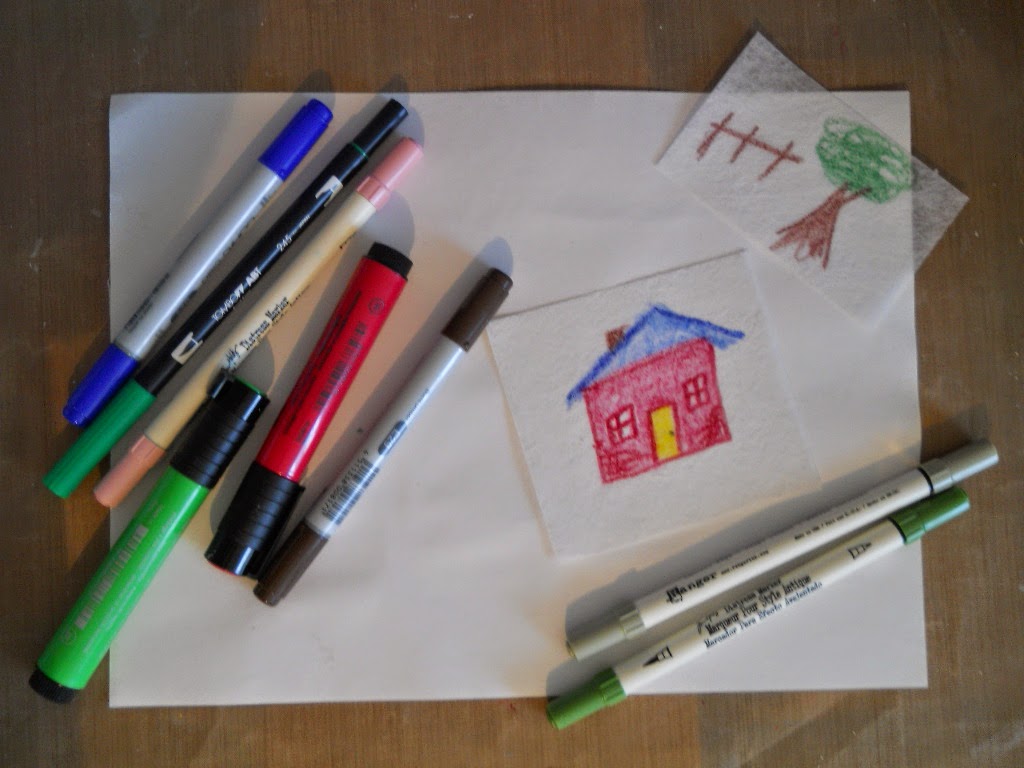
Next I used a scrap of Lutradur that I'd practiced drawing with crayons on.  The grand kiddies luv snail mail.  It needed to have the colours deepened and I used a variety of markers.
I would rather 'draw' on a scrap and then fiddle with placement later.  Takes the pressure away from that commitment to a blank white square, don't cha know!   ;}

 It looked a little forlorn in the centre of this card as the Lutrador didn't cover the whole surface so I added some washi tape borders.  Remember  when you fuss over the process that it is the thought that counts and the journey is progressive.  ;^)


I had a piece of medium weight Lutradur that I had embossed on the Bigshot.  I wet it and used Distress Paints to create a soft wash of colours.

 When it dried I positioned a stamp I'd prepared and cut out.

 This is more sophisticated and I think pop dots should hold the flower.  Very quick and satisfying.  


My thoughts turned to some dark Lutradur.  I wanted some glimmer.  The Radiant Rain nozzle was plugged so I just brushed some on.

 After it dried I ran it through the Bigshot.   I'm thinking I can get two cards with this particular process.

This is okay but...  I need to bump up the glimmer, perhaps a more opaque one.  Two works if the die is a bit smaller sized for the card and if I hadn't thrown away that wee bit between the branches.  ;)

 Next I stenciled a feather onto another piece of Lutradur that had a swipe of some kind of acrylic paint on it.

To show the translucence of the Lutradur I fixed it to patterned card stock.  Fun!


Lastly, I had another piece of Lutradur that had some spray on it and I masked off a flower and sprayed again.

A little addition of some washi tape and another card for the stash.  I try to keep them plain so I can use them for most occasions.  I could have done a few more but it was time to quit procrastinating and finish up the primary project for the week.  :)

Now I'm asking for help because the 12 inch square pages for the portfolio book each tell a story.  The current page is about helping with chores and needs to include past and present.  At some point I'll give a nod to the future. It also needs a wee bit of data.  Everything I put in as a purpose, at least to my mind.  But that is a lot for one page.  :O

 I started with a sheet of Lutradur that had photos printed on it.  They were too faint so I gessoed, painted, stenciled and sprayed the Lutradur.  The large piece wasn't going to do it so I divided it up, divided some more and spread them around to act as a corral for all the wildness in the middle.  Trimming and shuffling things around and taking stuff off and putting stuff back. ???  I thought about it while I fiddled with cards.

 "He who hesitates is lost.", to quote my dear ol' Dad!  It is what it is.

Ah, a final tweak.  I'll be adding a wee white "photograph' border around the page.  This one will finish 12 1/2 inches square.  Good enough.   Ten more to go.    Mother may need some more help!  :~)


Check out Elle at her blog... ellendacoop.blogspot.ca

Thank you once again Elle.... 

Jo 

Wednesday, May 14, 2014

Paint Glorious Paint 2...


 Paints Glorious Paint Part 2

 Part 1 was all about showing samples of mostly acrylic paints on Lutradur. And any that I have tried have worked so far.


I thought I would show you next was watercolours and some of the ways to add colour with paints.

Water colours are a great way to add colour when you want to add colours that are translucent, soft and show the fibers off. Please remember that I am not a painter. So I am using inexpensive water colours. Either the dry paint cake pallet from the craft store or the tubes in a set from the craft store are what I have used.
Below are some of the results of my experiments used the same paints but different weights of Lutradur from the C & T package. The picture shows the heavier weight with denser fibres. I have plans for these two “landscapes” to show you later…..
Heavier weight Lutradur

Lighter weight Lutradur


What interests me so much about using paint is that it is easy to use and clean up. I use a plastic table cloth to cover my surface paint away and let dry. I either use a folding table I own and leave it overnight to dry or if I am in the kitchen I have some old trays that I leave them on and move them to somewhere to dry. In her book Leslie says she often paints in her yard and lets it dry on the grass. At my house the wind would blow it away or my dog would try to fetch it. I might get some interesting paw effects on it.
                                                                                                                                           
To apply the paint Leslie commented that she usually uses a foam paint brush. My favorite ways are to spritz it on with a mister or sprayer nozzle. You can control the coverage by how much you spritz, how dilute your paint is and whether your Lutradur is wet or dry when you apply.
Spritzing over a stamped image

Spritzing on black 

Close up of Spritzing on Black. Notice the great highlighting of the fibres with the light application of the spritzing.


You can use a tooth brush to fleck it on for texture and dots.
You can use a myriads of different brushes.
You can smoosh with cling wrap, paper, or other fibers.
You can stipple.
You can use leftover paint to mop up.

You can use paint on stamps
You can use stencils.
Water colour through a stencil. 


One thing I want to try is to see if you can do sun prints with the Seta colour on the Lutradur.Does anyone know?  I will have to try that the next sunny day I am home.  It has been rainy weather here in Southern Ontario Canada this week.

Whats up next? Molding paste and Glass bead paste on Lutradur 

Jo 
thesewinggeek.blogspot.ca


Tuesday, May 6, 2014

Colouring with Inks and Lutradur...

Colouring with Ink.

The world of inks still confuses me at time.  There are so  many different kinds, brands and characteristics of each. Water based, pigment, acrylic, archival, dye based, acrylic ink, India ink, alcohol inks, distress inks, embossable inks etc.  I rubber stamped years ago and own a collection of various stamps. I have collected some ink pads. I also have some alcohol inks. I have some embossing powder. So how to use all these things and what different looks can we get with them?

First thing you need to consider are the properties of the inks.  Are they waterproof or not? Can your ink be used for embossing? Is your ink archival or does it matter? And what is your ink manufactured for?

These questions make a difference. As the product used may create a difference in your project. Or you may not worry about it too much and just experiment with it. Check the labels of your inks. Check the manufacturer’s web sites for information regarding their products. I get so much information from the web sites of manufacturers. They often have tutorials, projects and more. Another place to find information is the online art, craft and fabric stores. If they have it there is usually an explanation of the inks uses.

“Dye ink… saturates the spun fibres… acrylic inks which are made of pigments, behave like paints….” (Acrylic paints stays more on top of the fabric and you see less of the lacy structure. )  Leslie Riley.  
So pull out your inks….

Ink pads, refills, sprays, and alcohol inks and play. I am sure you may have different products than myself. So please let me know what you have and if you have tried it on Lutradur.

Here is what happened with the inks that I applied to the fabric. 

Pinta Alcohol Ink applied to dry Lutradur

Pinta Alcohol Ink applied to Lutradur that was damp. 


Pinta Ink applied to damp Lutradur with blending solution added to the ink. 
All samples were the exact same ink. You can see that different methods get different results.


Then I used some stamping ink ....
This first picture is the the two types of ink on just plain untreated lutradur. 

This picture is the same inks but the Lutradur was treated with a coating of soft matte medium. 
The image of the stamp is clearer on the matte medium treated Lutradur but you lose some of the lacy look of the fabric. 


Untreated Lutradur

Matte Medium treated lutradur

Same Staz On permanent black ink. The second image treated with the matte medium is crisper but once again you can see that the lacyness of the fabric is lost somewhat. How much matte medium you apply does make an effect of how much of the lacyness is hidden. 
And finally today
This is a picture of a piece of Lutradur painted with metallic paint. Stamped on with Staz On permanent ink with Pearl Ex powder added and then a "Lacing" technique that we will play with in the up coming month. 

Stamping with inks on Lutradur can be really versatile to use in Mix Media projects and Art Journals. 

What is your experience with inks? 

Jo 


Please check out my friend Elle. She agreed to play along this month with me. She has done her first post over at the coop (as she calls her blog) She is a talented lady! ellendacoop.blogspot.ca


Saturday, May 3, 2014

Colouring Lutradur 101

Colouring

This a subject that we all learned early in our life. In fact I would think that almost all who read this blog are intrigued and drawn to colour. While we spend a long time learning colour theory or exploring it, we all love colour.
 

There are so many ways to add colour to your work. Most work with Lutradur. You can try them all remembering that this is a polyester fabric and is translucent with fibers visible. It doesn't hurt to experiment even if the result is not what you were expecting. Creative design changes.... abound. 

Adding colour to Lutradur is a bit like a "dyeing day" Plan to cover your surfaces with plastic. Have somewhere for items to dry if you are using wet mediums. Create a bunch of coloured surfaces and make a few notes on paper, use your digital camera, use a sharpie marker to write on samples what you did. or doing. (Especially do this before you add colour if it is different paints you are trying. You won't remember... believe me... ) 

So what do you have around the house? And can you use it? 
Crayons? Yes
Inks? Yes
Oil Pastels? Yes
Paints? Yes
Dyes? Some
Patinas? Possibly

*For specific processes with Dyes and Patina’s you will have to check into Leslie’s book to find out the specifics because I haven’t played with any of them. So I can’t show any successes or failures. And there is certain products you can and can not use. 

Crayons…

Until I read this book I knew there were two kinds of crayons. The kind my kids used and I still like to use and fabric crayons which I had make tee shirts with 20 years ago. These are still the only kind I own.
Our regular old wax crayons will work. You can colour  an area… draw a picture… and highlight or maybe drip melted crayon on to the surface. 

To get some of the wax out and set, iron the Lutradur with the crayon side down with clean paper towel or paper underneath until there is no more wax transfer. I would use a warm iron. But too hot - above 400 degrees Pellon Corp tells us the fabric will melt totally. Or you may just melt it a bit and like it. Since the fabric is porous I would also use the paper towel on top to prevent transfer to your iron. Create a paper towel sandwich with the lutradur in the middle. 

Fabric crayons do not have the wax that the regular crayons come in. But they are heat set in the same way.
Let see how this works out…
Regular "Crayola" brand crayons out of the box. 
Regular wax crayons through a stencil then enhance with crayons. 


If you have other types of crayons try them. Crayola Twistable crayons.

And then childrens pastel crayons.

I also took a picture of one of my flowers and printed that on Lutradur. Then I took the crayons, twistable crayons and the pan pastels and highlighted the picture.
Here is the before picture

Here is the after...
After crayons, twistable crayons and childrens pastels added. This is shot on white paper...

And this is me holding the crayoned picture up in the air... 

I also tried using all three - crayons, twistable crayons and the childrens pastels through a stencil. 
First I used  pastels. 

Then I added details with the pastels, crayons and twistables. I also used a permenant black marker to highlight. I like this better than the plain pastels above. 
Stenciled using childrens pastels on black Lutradur adding highlights with crayons and twistables and then using a black permanent marker to do a bit of outlining and dots. 


If you have Caran d’Ache Neocolour and Metallic artist crayons and Caran d’Ache Aquarelle water soluble wax pastels can be used too. The water soluble crayons allow colour to be blended with water for softer effect. Has anyone out there tried these products on Lutradur? Let me know what you think of them. 

Note: The oil based crayons and the regular crayons will not blend. (More directions ----in the book page 8)

Oil Pastels.

Oil Pastels can be water based such as Portfolio Oil Pastels which are made to be mixed with water and can be blended with water. I have not experimented with these yet so I am curious if others have? 


Or with Shiva Paint Sticks (Markel Sticks) which are oil based solvent paint in stick form. These can’t be blended with water and need to be cleaned up with a solvent cleaner. If you have ever worked with Shiva/Markel sticks you know that they have to dry before heat setting to be permanent. The heavier you apply the longer to dry.

A great book to read about Shiva Paint sticks and how to use them is  Shelley Stokes' Paintsticks on Fabrics. Check out Cedar Canyon Textiles Inc site to find out more information about Paintsticks and more. Cedar Canyon Textiles

Below are some of my samples of applying the Oil based paint sticks to Lutradur.

Using Shiva (Markal) Paint sticks through a stencil. Here I mixed a few colours and added a heavy coat of the paint sticks. I did this to add depth and texture  to the piece. 

I put the lutradur over a rubbing plate and used two colours of  paint sticks. The reason I used two colours was that I did not secure the lutradur and rubbing plate and it shifted. But this makes a different kind of leaf. 

In this sample I wanted to see the difference between colouring on plain untreated Lutradur (on the left) and Lutradur that was treated with a coating of matt medium. I used Golden Matte Medium in this case. The coverage with the treated side is much heavier. 
For me I think that I would use the paint sticks mostly with using the lutradur coated with matt medium or through a stencil as in the first picture. Another way I would use them is to highlight which you will see in a later experiment. 

Leslie notes how fibres can be raised by pressing to hard and you can clip them or leave them. I found that a light hand was needed. I have a hard time with the smell of the oil paint sticks. It is a strong smell if used in a closed area. So you might want to make sure you have a window open. 

This is just two ways to add colour I have tried.

How have your experiences using crayons, pastels, paint sticks worked? Do you use it as a main colouring technique or highlight?

Next Up...  Colouring with Inks.....