A TECHNIQUE DRIVEN Blog dedicated to mastery of surface design techniques. First we dye, overdye, paint, stitch, resist, tie, fold, silk screen, stamp, thermofax, batik, bejewel, stretch, shrink, sprinkle, Smooch, fuse, slice, dice, AND then we set it on fire using a variety of heat tools.

Showing posts with label dye drawing. Show all posts

Wednesday, March 25, 2015

First in Missed Beat Series

Recently I discovered that I have an occasional irregular heart beat.  Doctor says that most people have an occasional irregular heart beat and it means nothing.  In fact, now that I know it means nothing I lay in bed at night listening to my  heart beat and think it is cool when I hear (well, actually don't hear) the missed beat.

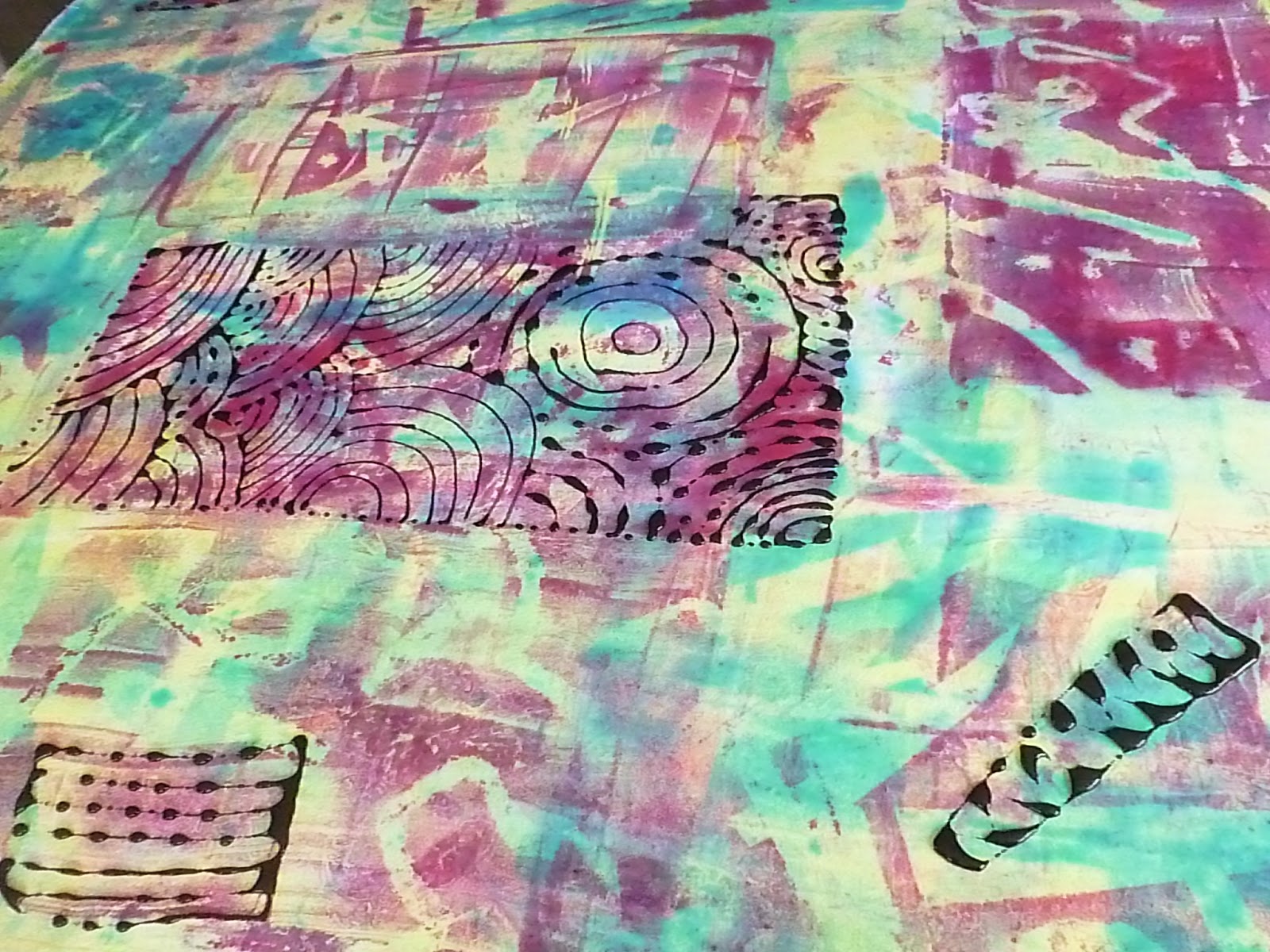
I am telling you all this in order to introduce my Missed Beat series.  I am taking a print class at UMA and am working with thickened MX dyes on fabric for my prints. Fabric is 60 inches by 36 inches. Now it is a print class so I am printing with multiple deconstructed screens rather than painting but drawing with thickened dye is included in the work.  And, the deconstructed screen is used as texture and specific shapes rather than just a one-off print of the screen.

Below are process pictures and then the finished piece.  I am pleased.  All that practice with drawing lines was definitely worth it.  Enjoy.

First layer batching under plastic.

A screen after deconstruction.

Brown paper to cover shapes while I work on the background.

Finished background.  Now time to work on the shapes.

I don't show  you but I used more brown paper to cover the background while I worked on the shapes.


And then I drew lines.

 Details of lines


Detail of background.

 Brought to you by Judith

Monday, March 23, 2015

Quality of Line

Lets go back to this wild child.  It is a  wild child for sure.  Here it is washed out.

I was hoping for an exciting piece.  I needed a bold statement line to get that effect.  Now with the bubbling of the thickened dye I got a bit more wild child than I had intended but I like it. It would have been a very different  piece, a Miss Manners piece, if I had chosen a different quality of line.  Not saying that is bad.  Just saying it would have been different.  So lets look at some of wild child's lines.


The fabric was dry (which probably increased the bubbling situation) but I laid all the lines down in one sessions and the lines bled into each other.  Isn't that great here?  Didn't work on other pieces like the IRO inspired pieces but is great for this one.


The washed out wild child was unbalanced.  I had used too many dark colored lines in some places and too little in others.  I needed to balance it.  More lines in its future.  Beth said she got a consistent line by putting the tip of the squirt bottle on the fabric.  I tried it. See that straight line up the middle of the picture? And the navy blue circles?  UGH!  GAG! Good line for somewhere else but it did not fit with the rest of the piece.  The wild child was just not that well-behaved and sedate.


So, worked on stronger lines but I was working on a new layer rather than with all the lines wet and bleeding into each.  See the difference? The new line doesn't play as nicely with the others.  But it is worth noting that it is more distinct.  Good to know for the future.


I had great fun with the wild child.  It took me three dye sessions to get her finished but so what.  Rome wasn't built in a day.  And I learned a lot about drawing lines with thickened dye.

Brought to you by Judith.

Friday, March 20, 2015

Now we are having fun!

Searching for cool art on the internet I found the work of Lena Nyadbi and Betty Mbijana.

First Artist Inspiration

"Lena Nyadbi is a contemporary Indigenous Australian artist from the Warmun Community in the Kimberley region of Western Australia." More information about her can be found here.  Isn't she fabulous?  Her is the picture I used as one inspiration.


I started out with a pink and blue screen print that I hated. Then I squirted lines on it.  I like it better but the line quality is all wrong. Don't they look like your sex education class drawings of sperm?  This piece definitely needed painted lines rather than squirted bottle lines.


Second Artist Inspiration

"Betty is a hard working artist, whose works are very popular and have wide appeal. 
The paintings are aerial views of women's ceremonies and depict the waterholes (often in sacred places) where they take place." She does not have a website but here are more images of her work.  This is the one I used for inspiration.
  So starting with a yard long piece of cotton that I had already done some surface design on I started drawing trying to emphasis the underlying designs.  Of course I was using my handy dandy hair-dye squirt bottle.  She used a brush to create hers.  I am still trying to master my squirt bottle so ...


Because the cotton was very tightly woven the dye did tend to bubble more than it would have on muslin.  You can really see the bubbling on most of the pictures.  Since I didn't care whether the lines were perfect or not (think of it as an element design) just kept going.


See the copy of the inspiration art in the above picture?

Brought to you by Judith

Wednesday, March 18, 2015

Intent and Line


I don't know if you read comments or not but I have gotten a few comments about my use of dye to draw lines.  I think those are good comments and deserve some discussion. The technique I use for a line depends on my intent and on the quality of line I think will get the job done.

One artist said she uses a stitched or quilted line in her work.  My self-portrait above is a good example of using stitching to create a line.  As my mother told my soon-to-be husband, I have the "soul of an artist."  Now my mother meant that I don't clean house but I wanted this small wall hanging to show my artistic soul and downplay my physical habitation. That was my intent for this piece. So, I used ink to give the background some color, to move it into the background, and to ground the figure so it was not floating.   I finished the background with some meander quilting for texture without drawing interesting to the stitching line.  I used bold commercial fabric for the shadow to really make a statement but be dark enough to be the shadow. AND I used a stitched line for the figure because I wanted a thinner, more delicate line to show details.  Drawing a dye line would have been too strong of a line for the intent of the piece.  It would have said something different than I wanted the line to say.  So, I chose a stitched line in this case.


Another artist said that there are so many different options to make a good line why did I bother with the dye. Again that is a good point and is answered again by asking, "What is the intent for the piece and what type of line is needed?"  In this snow dye piece I saw a flower garden and wanted to enhance that.  For this line I used a micron pen.  It gave a solid consistent thin line that I wanted for the piece.  That worked well because I knew I was going to use some chalk (also known as fugitive media) to enhance the flowers so I could "fix" it all when I was done. A dye line would have taken away from the delicacy of the flowers.  A stitched line would have been difficult with so many individual petals.

So why am I using a thickened dye line in these pieces?  

First, Intent.  Right now in my art career I am spending more time in surface design than in sewing.  Right now my goal with each piece is to create an artistic design that stands alone.  Or in other words, doesn't need stitching or quilting or thread drawing to complete the design.  I want to create something that could be framed or stretched without adding any embellishment to it.  That is my intent so I am experimenting with a thickened dye line. 

Second, Quality of Line.  I want the line to be bold, obtrusive, an independent voice in the design. I want it to be free and loose and have some texture of its own.  I want it to have weight. I like the work that Ayn Hanna is doing and so I am experimenting to see if I can produce such a line to incorporate into my work.

Good news is that with practice my lines are getting less gloppy and blobby and are starting to say what I want them to say.  Stay tuned.

Brought to you by Judith.


Monday, March 16, 2015

Third IRO experiment. Still not as good as IRO

Okay, still being influenced by the IRO video I tried another piece.  Still scraping the thickened dye on with a credit card, still using a squirt bottle (Did I tell you that I use the squirt bottle from my hair dye?  Waste not want not.)  Still being silly enough to move the piece while it is wet. (In my defense I made these three all at the same time so I didn't know how bad of an idea it was.)  Still working wet on wet.  The new thing is that I used black and red dye to draw lines and I tried a bit more complex of a design.


Before the detail shots did I ever tell you why I use a credit card to scape on the thickened dye?  Primarily because it is faster when you are laying down a solid color.  If the space is small, then cut the credit card in half or fourths.  If you want to paint with highlights and shadows then a brush is  your best bet.  Okay, now the details.  Watch for the same mistakes of smears, smudges, and bleeding.  Will I ever learn?


Brought to you by Judith

Wednesday, March 11, 2015

First IRO Inspired Experiment

Beth and I got together to try the drawing and painting with thickened dyes technique that she found on the IRO YouTube video.  Here is an image in case you forgot how magical their fabric looks.


I had found two images on the internet that I thought would translate well using the painting and drawing with thickened dyes techniques. The first was very geometric.

 I drew on the cotton fabric with a pencil first to get the overlapping shapes I wanted.  Then I scraped on the thickened dyes with a credit card.  While it was still wet I used a squirt bottle to lay down the black lines.  I then covered it with plastic, moved it to batch, then after an hour rinsed it out.  Here is the finished piece all washed, dried, and ironed.  Detail pictures follow.


See all the yucky smears? I moved the piece while it was still wet.  Not a good idea.  And did you see the black shadows around some of the lines?  That was because I rinsed it out while the dyes were still wet and they tranferred.  And did you notice the bleeding of the black lines?  I think that was caused by working wet on wet but it could just be because I squirted too much dye onto the fabric.

On the positive side, did you see the lovely shadings in the colors?  That was because I used credit cards to lay down the colors.  I was quite sloppy with the dyes and left extra dye along the credit card lines. Where the dyes were thicker the color is stronger.  Love it!

Judith

Friday, March 6, 2015

Another Line Added to the First Experiment

I wanted to add another line to the daylily drawing but I knew I was really bad at using the syringe to draw lines.  So first I practiced drawing with the thickened dye.


Still not great but getting better.  I learned that whether I am putting pressure on the plunger or not, the thickened dye will ooze out.  So I started using a drip rag to wipe the tip of the syringe between drawing with it.  That helped.  I also tried starting off the edge of the fabric so the blob would be somewhere else.  That also helped but it is not always a choice.  I was not particularly pleased with the quality of the line.  Too thin for the emphasis I wanted to give the flower.  Now the syringe I was using is the kind of syringe with the really tiny curved tip.  I might have gotten better results with a syringe with a larger opening--like a syringe for giving children their liquid medicine.  But I think I may be done using a fine tipped syringe.


Here is the daylily painting with the added dark line. I do like it better.  Not perfect but better. And here are some detail pictures.


You know, putting much more emphasis on the flower even makes the more impressionistic background look a little better.  However, the black lines in the background should just disappear. What a mistake! They only emphasis the stems and leaves going no where.  Didn't need/want that level of clarity for the background.

Judith