And then we set it on fire… well maybe not but
playing with heat tools…
This title is what attracted me to read this blog in the
first place. It is a cool title.
Today is the day we look at heating Lutradur.
Tools needed a heat gun like the type used in embossing ink
for stamping, a soldering iron or a tool like the Creative Hollow heat tool. I
have a “Martha Stewart” heat tool. (It was the right price)
++++Do not use a heat gun like the type to strip paint. This
is not safe and too strong of a heat.
Safety notes:
-Lutradur is a
polyester product so use your heat tools in a well-ventilated area. To be safer
use a mask or respirator designed for fumes.
-Have tools on hand
like a skewer, awl, tweezers, or other tool to hold the Lutradur in place.
-Use the tools on a
heat protected area. An ironing board, glass pane, cookie sheet. Do not do on
top of your table unprotected.
-Know where your fire
extinguisher is (preferable close by) or a pan of water beside you.
-Use your Teflon
ironing sheet. Use for protection of your surface or as a shield.
Before you see my examples let’s take a moment to have some
hints from Leslie Riley www.leslieriley.com
This is a picture Leslie sent me to
show how she has used heat tools to cut Lutradur. See her heat tool in the
right upper corner of the picture?

Hints from Leslie….
Jo: If you could name just one technique as your
favourite what would it be? And why?
Leslie: I still love what attracted me initially, burning
organic edges. I love the magic and power behind taking the heat tool to the
edge of a piece of Lutradur.
Jo: The blog that we are writing for is …and then
we set it on fire… what is your best story on using a heat tool or soldering
tool and having it burn a bit too much. Could you use your “mistake” and turn
it into something interesting?
Leslie: In my early
days of transferring images, I read that applying a solvent to a magazine image
of those early color copies and then heating it would create a good color
transfer. So I iron the paper that I had painted with solvent. Big mistake.
Solvents are combustible. A small fire ensured on my ironing board. Fortunately
I was able to put it out quickly.
Other than that, the
only other heat tool story is placing my hot tool onto a plastic table while
teaching and burning/melting a hole into the table. Obviously I stress proper
use and resting places for your heat tool. A tall heavy empty jar is a great
place to put a hot tool while you are working.
Now into heating. We have our area set up so we are safe….
Lutradur will melt to nothing if you apply to much heat to
it. Like anything else you need to practice with the tools you have to get
effects that you want. If you heat an area to hot you may burn more than you
expect. But this can be a creative opportunity or as I like to say a creative
design change.
First we will use the Stamping Embossing Gun to “Lace” our Lutradur.
When you use the heat gun let it warm up first. If you put
it over your Lutradur when your first turn it on you will not get the heat the
same as when you have it on for a minute. Start out moving the heat gun over
the area you want to “lace”. (Leslie calls this technique lacing)
The farther away from the surface the slower the Lutradur will melt. If you move the heat gun closer to the fabric the rate of melting will increase. So if you are new to heating keep the gun higher. Also the rate you move the gun around the surface will also slow the rate of melting. If you want greater lacing as opposed to melted holes than move the gun around in small circles and hold it higher above the fabric.
The farther away from the surface the slower the Lutradur will melt. If you move the heat gun closer to the fabric the rate of melting will increase. So if you are new to heating keep the gun higher. Also the rate you move the gun around the surface will also slow the rate of melting. If you want greater lacing as opposed to melted holes than move the gun around in small circles and hold it higher above the fabric.
This is a skill that is easy to do but hard to control.
Let’s look at some pieces I have laced.

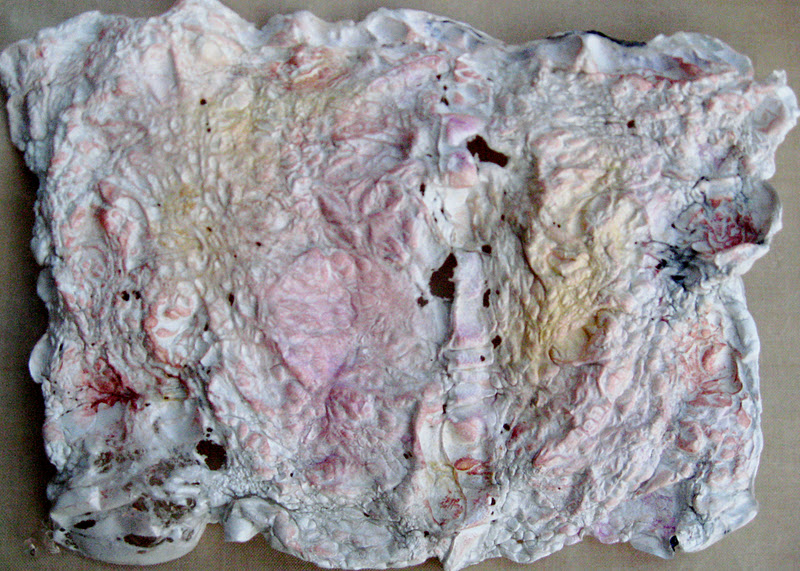
This is the piece of black Lutradur that I used the Golden
Glass bead medium through a stencil. I decided I wanted to create a ethereal city … and I might achieve this with lacing.
I decide to quit lacing when I got to this point.


This piece
Was stamped then laced…

Sometimes the material you colour with will act as a resist
to melting… or at least the resist area won’t melt as quickly. Acrylic paint
can act as a resist but also the bead gel medium did so in the above picture.
My friend and fellow Fabrigo Robynne wanted to try to do
lacing. So we pulled out the heat gun and started running it. We used my Teflon
sheet to shield areas she didn’t want to get to much heat on. She wanted to
burn the edges of the Lutradur but had already sew it to her piece.
 |
| Robynne Cole SAQA and Fabrigos. Portion of a work in progress |
 |
| Robynne Cole SAQA and Fabrigos. Portion of a work in progress |
In another part of her piece the shielding worked and the
edges of the Lutradur was given the slight organic laced look she was going for
as opposed to a crisp even cut edge.
I love this look!
My friend Karen from Fabrigos also make a picture from
Lutradur. She used my ship picture, free motion stitching and used lacing to
get a really amazing look. I can only show you a peek of it now.

To use the soldering iron or the creative heat tool…
Some hints of caution…
- make sure you have a place for your
soldering iron to rest when not in use. If the tool does not have a reliable
stand (like mine) use Leslie’s tip and use an old glass jar. Ineke Berlyn in
her DVD with colouricious.com on Lutradur use a clay garden pot with a hole in the
bottom. The pot is upside down and she puts the tool into the hole. I am sure
there are more great suggestions out there. Just make sure the tool is stable
when you do not have it in your hand.
-My tool also has to be completely cool to change tips. Don’t
touch the hot tips!
So with your heat proof surface ready try some lacing with
your soldering iron/heat tool.
I use my portable ironing board with my glass plate on top.
I want to also try this with a cookie sheet sometime.
These are
the tips that come with my Martha Stewart Heat Tool. I choose to use the one in
the front of the picture. I tried to take pictures of me actually doing the
work but I could do the camera and the heat tool. I am sure there is a way.

When the
tool was hot enough ( a few minutes at best) I took my tweezers and held on to
the lutradur and put the tip to where I wanted to have the Lutradur melt. I
wanted to accent the white spaces that were left in the stamping.
Below I did a wavy line to take off a
piece of the lutradur that was not coloured.

Here is the piece below all finished.
I can imagine it in apiece with leaves, or part of a post card or other card….
Somehting in my box of tricks to use when inspiration hits.


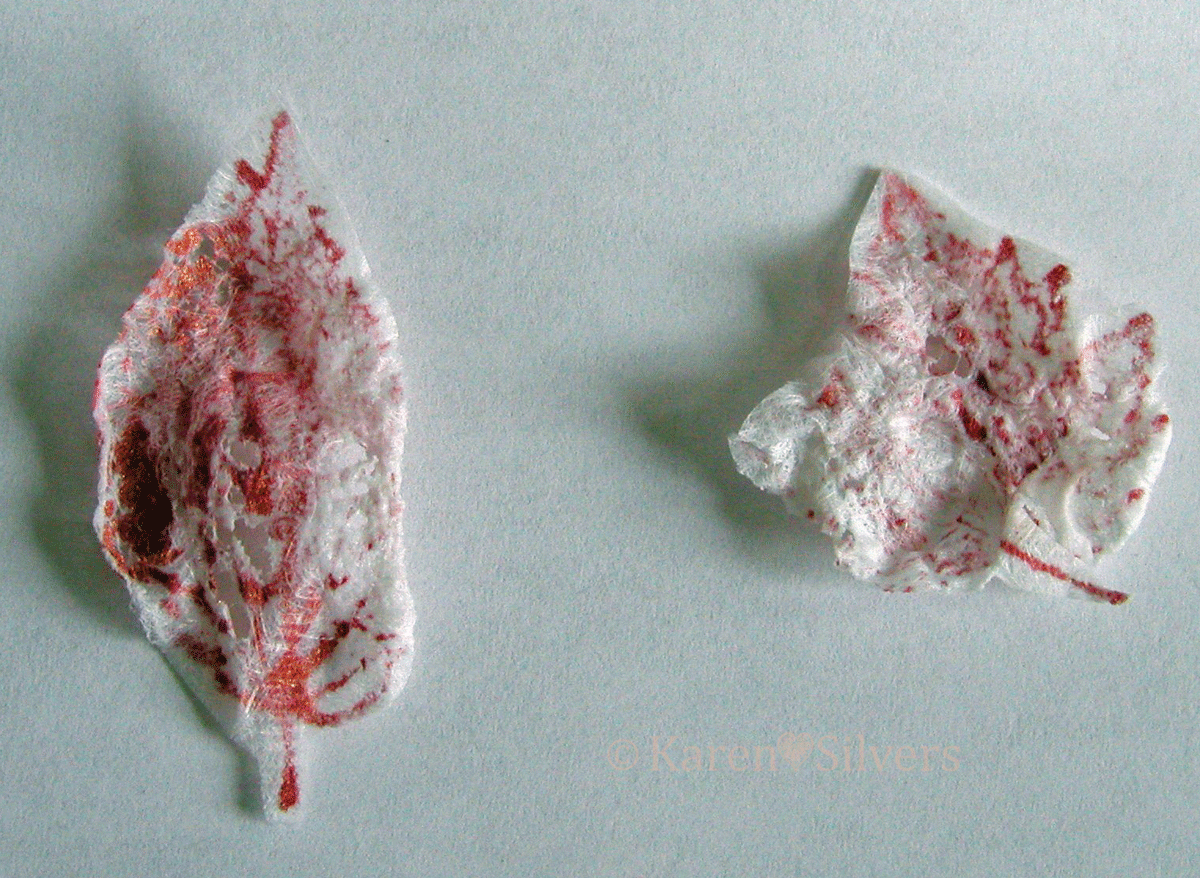
In the
picture above I traced out leaves form mylar templates. I made the templates my
self from taking leaves from my garden. I scanned the real leaves into my computer. I printed the page out and traced
images. In some cases I enlarged or shrunk the size of leaf so I could have
multiple sizes. I use the templates when I cut out leaves from fabric for 3
d stitched leaves in my pieces.
Below
is the traced leaves. I used a sharpie
pen and free handed leaf veins.


This is a leaf that I made
from the molding paste and a stencil. I melted some of the leaf veins and used
scissors to cut around the leaf. On the right back ground this will provides
great texture and dimension to the piece.

Using the embossing heat tool gives you wonderful looks. The
soldering iron/heat tool gives you a more subtle effect and more control over
your melting. So far I have not set
anything on fire. But melting things is addictive!

I have been really enjoying our time together.
I still have many more things I would like to show you. If I
don’t get it all posted this week I will continue on my own blog… monitoring my
experiments with all the wonderful techniques out there. I am really thankful
for all the artists who have shared with me. And the graciousness of them to
let me show their work.
I hope you have enjoyed this
month as much as I have… a few more technique’s to go but there is lots more in
Leslie's book and the other books an DVD’s that are out there. People continue
to amaze me at what they come up with.
Jo
http://thesewinggeek.blogspot.ca
Remember to win an e copy of Leslie Riley’s book from C &T publishing. Comment on this blog post or any post from this series of Lurtadur posts.
And as a Bonus Prize of Lutradur samples and goodies from me do one of three things.
· Having a tip that you have shared on the days topic
· Tell me you have tried something as a result of this month’s post tips and what it was
· If you have gone to my blog and become a follower.