A TECHNIQUE DRIVEN Blog dedicated to mastery of surface design techniques. First we dye, overdye, paint, stitch, resist, tie, fold, silk screen, stamp, thermofax, batik, bejewel, stretch, shrink, sprinkle, Smooch, fuse, slice, dice, AND then we set it on fire using a variety of heat tools.

Showing posts with label Laura. Show all posts

Thursday, February 20, 2014

Dyeing two pieces with the same colors-very different results

These two pieces were folded up and each dyed with the following dye concentrates:

  • 2 T boysenberry
  • 2 T navy
  • 1 T tangerine
  • 1 T strong orange

The only difference was applying the soda ash solution to one piece before adding the dyes, the other adding the soda ash after the dyes had been applied and waiting about 10 minutes.

Here they are waiting in my sink to be rinsed out:

The before piece is on the left below, the after on the right--they don't look similar at all, do they?
This shows that the tangerine & orange blended a bit with the navy and made a nice green, while the same colors pretty much disappeared in the piece that had the soda ash applied afterwards.
I'm just experimenting with the low water immersion techniques--I'm not fond of either of these pieces and will probably overdye them, but this makes me realize how little variations in dyeing techniques can make a world of difference.

Wednesday, February 19, 2014

Reposting-Dyeing Turquoise using LWI

Laura's post--(sorry the pictures didn't show up in the one I sent to Beth for posting)

Using Turquoise in LWI dyeing

I experimented with using Turquoise dye powder and the low water immersion method, because Turquoise is the one color that the dye experts tell you has to stay on for 12-24 hours in order to bind to the fabric.  I love using turquoise, and was wondering how it would work to use this method that only requires one hour of batching your fabric.

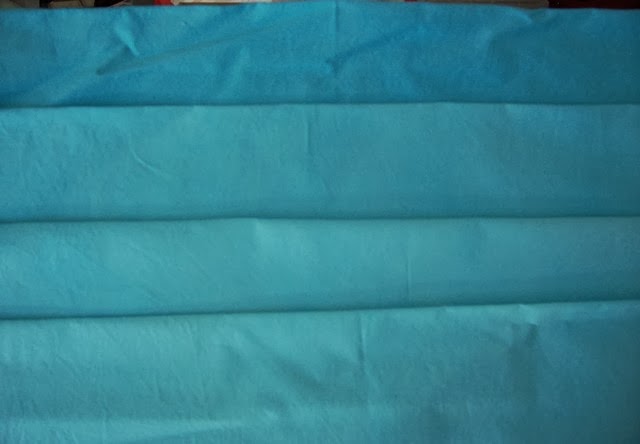
I dyed four fat quarters using 1/4 cup water and 2 tablespoons of dye concentrate.

One piece was left in the dye for one hour, the second for 2 hours, the third for 8 hours, and the last for a full 24 hours.

The value different is subtle, and hard to see in these pictures, but the one-hour piece was almost an icy blue, while the 24-hour piece was a slightly deeper shade of turquoise.  There was hardly any difference between the one-hour and two hour pieces.

So, my conclusion is that if you are using Turquoise in your 1 hour LWI dyeing, you might want to mix up a stronger concentrate so it isn't lost during the washing out part of the process.

Thursday, February 6, 2014

Parfait Dyeing

Posted by Laura McGrath-guest during February--

Lots of fun stuff going on here with Ann Johnston’s DVD Color by Accident this month!  I’m going to show my results with some of her Parfait Dyeing technique.

First, I mixed up all the dye solutions, using the 14 pure colors.  I used 2 cups of water and 3-4 tablespoons of dye powder to each bottle.  (And realized later, after doing a bunch of dyeing, that I forgot to add the 4-8 tablespoons of urea that I was supposed to include—whoops!)

For the parfait dyeing, I wet my fabric pieces that were each about 18” x 44”, and wrung out the excess water.  Then I put one piece in a large jar and scrunched it up really good.  I took a one cup container and put about 4 tablespoons of Intense Blue dye solution in it, then filled with water to have a full cup.  I poured it on the fabric, waited about 5 minutes, then poured in about ½ cup of soda ash/water solution.  Second piece was done the same way, this time using Tangerine dye solution, and adding soda ash again.  For the third piece I used Strong Orange dye concentrate, and again added soda ash, and squished it all down tightly.

Then I waited an hour, and rinsed it all out, and washed in the washing machine.

Here are the finished pieces:


I did this whole process again, the second time using a stronger solution of the same dye concentrates (8 tablespoons dye solution of each color).  I thought I would get a really deeper color, but it didn't make it twice as dark.

Here are the two sets side-by-side--


It surprised me that the Tangerine and Strong Orange colors were pretty much taken over by the blue, creating so much green.  The best part of this process is that it was SO easy! 

Check out more of my Ann Johnston dyeing results on my blog, Periwinkle Art Quilts.

Friday, September 23, 2011

Fugitive Media

Finally, I've had some time to try out this technique! I used some regular pastels on white fabric, just drawing some flowers out in various colors. Then I painted the whole piece a very light lavender using Pebeo Setacolor paint, covered it with textile medium using a screen, and quilted some outlines in black. Here's a picture from late last night when I finally had to put it away and go to bed:

More flowers. It was a lot easier to draw the flowers out first, then sew around them. The textile medium I used seemed to create almost a laminate type of fabric. Definitely gave my sewing machine needle a workout--I want to wash the piece to see if it softens up a bit.

And here's another piece I painted some flowers on with setacolors in pink & yellow, then drew the leaves in with pastels. I learned that the setacolors are pretty transparent and the pastels aren't, as you can see in the leaf on the right side.


I took the textile medium and applied only to the green parts with a brush, then heat set the piece with my iron and threw it all in the washing machine. No fading or anything following the wash.


Finally, this last piece was from the challenge we had recently--there was too much white on it when I got it back, so I decided to color in the white lines with a blue pastel crayon. It actually looks purple in this picture, which makes me thing I might want to color it over in purple.


I screened the textile medium on this, too, and washed it, but it still feels kind of stiff. I just got a cheap medium at Joann's or Michael's, if someone is using a better one that doesn't stiffen up the fabric, could you tell me which one I should try?

Friday, July 22, 2011

Using some shibori fabric

I was finding it hard to use some of the shibori fabric I've made, and finally came up with a design that I think shows it off. This is a simple piece with 2 1/2 leaves on it, measuring about 36" wide and 42" long, quilted with a simple design of lines on the green background.

The green fabric is sateen that I dyed using some avacado colored dye. It has a nap to it, and I deliberately placed some of it going one way and some the other, giving the color difference shown.

I'm still quilting some of the individual lines on the leaves using both brown and pink thread. Good way to spend the day today, inside in the AC instead of out in my 120+ degree garage doing monoprinting or dyeing.

Monday, February 7, 2011

Batik

Where did the weekend go??? I didn't get started on any batik until late Sunday afternoon, first I waxed some large leaf designs on a piece of fabric that was around 18" x 44.
Then I stretched the fabric over a large box, pinned it in place with push pins, and took it outside to paint. Which I could do because it was in the 50s and sunny.

The leaves are painted with avacado and the background blue is sky blue. Had to keep moving the fabric down and repinning it.

Here it is all painted--I went inside to get a large garbage bag the cover this so it didn't dry too quickly in the sun, and by the time I got back outside, it had blown across the lawn because it was kind of windy. The blue and green blended by rolling across the lawn, which I didn't really want to happen.

I left it overnight, will have to work on it again tonight after work.

I also had time to wax another small piece, this was done with a weird kitchen tool that I got at the Goodwill store. I mixed up a little rust orange dye, then left this overnight. Rinsed it out this morning--think I might dye this again in a warm yellow after I remove the wax.

Tuesday, January 4, 2011

Arashi shibori

My recent attempts at pole wrapped shibori.

Supplies all ready to go.

Two pieces of fabric fabric wrapped around a piece of PVC pipe (around 8" in diameter, I think), with dye mixture squirted onto them. I think this was navy blue dye, and one piece of fabric started out white, the other was a light grey.

A close-up:

And here are the finished products--
light grey piece with navy blue dye

And navy blue on white fabric:


I'm going to try this again, using the paint-on method used by Beth from Maine, and see how that works. I also have some silk scarf blanks from Dharma that I'm going to use the Procion MX dyes on and see how they turn out.