A TECHNIQUE DRIVEN Blog dedicated to mastery of surface design techniques. First we dye, overdye, paint, stitch, resist, tie, fold, silk screen, stamp, thermofax, batik, bejewel, stretch, shrink, sprinkle, Smooch, fuse, slice, dice, AND then we set it on fire using a variety of heat tools.

Showing posts with label dyeing. Show all posts

Monday, May 1, 2017

A Little of This, A Little of That

When Beth asked if I would commit to a month of posts this year, I hesitated – what can I say that hasn’t already been covered wonderfully by so many in past months?  She thought if I did a little recap of what I have done over the years, it might make for interesting reading. 

First off, I do think of myself as a “fiber artist” – a term that means different things to different people. Wikipedia defines fiber art this way:

"Fiber art refers to fine art whose material consists of natural or synthetic fiber and other components, such as fabric or yarn. It focuses on the materials and on the manual labour on the part of the artist as part of the works' significance, and prioritizes aesthetic value over utility."

Well… I typically try for a happy balance between functional as well as decorative.  I strive to make items that are unique, but definitely useful, such as clothing and household items.  I will be talking about these during the month.

I am also someone who likes to re-use and re-purpose, as well as conserve.  If you sew, especially you quilters, you probably look at fabric scraps the way I do: “I’m sure I can find something to use this for”, and thus the fabric stash grows and grows!  I will be talking about some ways I have found to use those scraps, even going so far as to demonstrate one way I have used up my spare thread stash… the threads that are snipped from sewing projects, spool ends, etc.

I should note here that I primarily make my items for sale – I am a member of our local Artists’ Coalition, and have been part of our Artists’ Co-op gallery for over a year, so my first thought when working on something is : will this sell?  And I have developed a group of items that have become good sellers.  But if you make things for yourselves, or to give as gifts, I’m sure you can adapt some of the techniques I will be discussing here for your own projects.

So just to give you a recap of what I hope to cover this month:  a brief glimpse at a dyeing technique I learned last year, with a link to a great on-line class where I learned the technique; another fun dyeing technique I have enjoyed using for dyeing silk scarves; several ways to put a dent in our ever growing fabric and thread stashes; a couple of great links to on-line tutorials, and reviews on a couple of great books I have used for one of the techniques. And to finish out the month, some examples of a new technique I am finally learning to use to dye chiffon scarves, but it can be used on other silks, as well as cottons.


So stay tuned… I hope you enjoy this month’s posts, and would love to hear your comments or questions as we go thru these subjects!  

Friday, January 15, 2016

Dyeing by Weight Vs. Volume 3: Showing the Difference Between Fabrics Where Dye Was Measured vs. Weighed


In this post, I (Diane) will show you 6 different pieces of fabric, 2 each of red, yellow, blue. One set of fabrics was dyed with dye powder that was measured. The other set of fabrics was dyed with dye powder that was weighed.

For this experiment, I actually calculated the correct amount of dye and auxiliary solutions needed for the weight of my fabric and the depth of shade that I wanted.  Each sample was 6” by 14” and weighed 7 grams. I decided that I wanted a depth of shade of 4%. This depth of shade gives the fabric a medium-dark color.

Using the formulas already available in the Dyeing Alchemy workbook, I calculated that I would need 0.3 grams of dye powder to get a 4% depth of shade for this amount of fabric. This is the amount of dye powder I need for each piece of cloth in the "weight" part of the experiment. The formula I used was the weight of fabric in grams times the depth of shade percentage. If my scale had been accurate to two decimal places, I would have seen that the correct amount of dye powder was actually 0.28 grams rather than 0.3 grams, but the later amount is accurate enough for most purposes.


Since I was dyeing small amounts of fabric, I decided to mix my dye powders right in the cups in which the fabric would be dyed. Each cup has been labeled with the color of the dye and an indication of whether the dye has been weighed or measured.


To help the dye powder dissolve, I have put 1/8 teaspoon urea granules into each of the 6 cups. The amount of urea is approximate. From experience, this seemed to be a good amount to use for a small piece of fabric and small amount of dye. I could also have dissolved the dye using urea water rather than plain water, but generally I prefer using urea granules since they act like small ball bearings that help dissolve the dye powder.


For the cups where the dye will be weighed, I used the same process as in earlier posts: I put the cup with the urea granules on the scale, tared the scale to zero, and weighed 0.3 grams of dye powder. (As in earlier posts, I worked in a sink below my face, with damp paper towels in the sink. I also wore a mask and gloves.) Once I measured 3 colors of dye powder, each into its own cup, I was through with the part of the process related to dyeing by weight. 


I then had to figure out how much dye powder to use for the samples where the dye powder was being measured by volume. I looked in my dye books and on the Internet so see if I could find an agreed-upon volume figure for the weight of one gram of dye. I found some information that said 1 gram of dye powder is about equal to ½ teaspoon of dye powder. This is the information I used in this experiment. (This does not correspond, however, to the weights I got in my last post, but more about that later). Using the following formula:

1 gram/.5 teaspoon = 0.3gram/X teaspoon,

I calculated that X = 0.15 teaspoon. This is a little more than 1/8th teaspoon (=0.125). So I measured out a scant 1/8th teaspoon of dye for each sample dyed by volume and added it to the appropriate dye cups which already contained urea granules.


Next I needed to figure out the liquids I would add to the dye powder in each cup. Using the Dyeing Alchemy workbook, I calculated that for each 7 gram piece of cloth, I would need to use 70 milliliters of total liquid, divided into 32.5 ml. of water, 22.4 ml. of salt stock, and 10.5 ml. of soda ash stock. In this instance I used a 10:1 liquor ratio where the amount of liquid is 10 times the weight of the cloth (10 times 7 = 70 ml of liquid). 70 milliliters of liquid (a little more than a quarter of a cup) is enough to cover the fabric piece once it is squished down. Since this formula for liquids includes 13.5 milliliters of dye stock to make up the total of 70 milliliters, I used about 46 milliliters of water instead of 32.5 to compensate for the fact that I was working with dye powder here rather than dye stock.


Next I labeled my fabrics. I used little pieces of Tyvek that I stapled on the corners of the fabric. I like using Tyvek labels rather than a marker notation in the corner of the fabric pieces since they will show up no matter the darkness of the dyed fabric. Marker notations on the fabric itself may be obscured if you are dyeing the fabric a very dark color.


Since I needed about 276 milliliters of water total for the 6 cups, I poured about 300 milliliters of water into a measuring cup and heated it in the microwave. I then used a thermometer to make sure that my water was about 105 degrees Fahrenheit (40 degrees Centigrade). This is on the high side for mixing dye but I knew the water would cool a bit while I did the other steps in the process.


I also got out my bottles of salt stock and soda ash stock so they would be ready when I needed them.


For the first dye container, I measured 46 milliliters of warm water into a measuring cylinder. I then poured a small amount of that water into the first dye container and stirred it with a spoon. As the dye dissolved, I added a little more of the water. When most or all of the dye was dissolved, I added the rest of the 46 milliliters of water and stirred the dye until it was fully dissolved, translucent and without any dye granules on the bottom of the cup. The urea granules helped to dissolve the dye powder quickly. I repeated this process for each of the other 5 cups.


Next I measured 23 milliliters of salt stock into each cup. I didn’t bother to heat the salt stock since I was using such a small quantity and had already heated the water I first put into the cup. I put this amount of salt stock into dye container and stirred.

The next step was adding each labeled piece of fabric to the appropriate cups. After adding each piece of fabric, I squished it with my gloved fingers and massaged the dye into it. I did this for all 6 cups, rinsing my fingers in between handling each piece of cloth. I left the cups for 15 minutes, stirring and massaging the fabric throughout that time. Then I moved the fabric pieces to one side of the cup with a spoon and poured 10.5 milliliters of soda ash stock into each cup. I left the cups for another 60 minutes, stirring each frequently. Then I rinsed, washed and dried the fabric in the usual way.


Below is a picture of the finished 6 pieces of fabric. The fabric where the dye was measured is on the left. The fabric where the dye was weighed is on the right.

You can see that for the blue and yellow dyes, the cloth where the dye was measured is darker than the cloth where the dye was weighed. For the red dye, the colors are pretty close though the piece where the dye was weighed may be slightly darker than the piece where the dye was measured.

BUT, as I said above, this color difference could be an artifact. In my middle post this week, all the teaspoonfuls of dye that I weighed were between 3.8 and 4.9 grams, with an average weight of 4.4 grams. This means that an average 1/8th teaspoon of dye would weigh 0.55 grams which is almost twice the weight of 0.3 grams that I used for the "weight" part of this experiment. That alone could explain the discrepancy in color between the two pieces of each sets of fabrics, since the pieces dyed with the measured amounts of dye had almost twice as much dye as the pieces with the weighed amount of dye. The only way to know for sure would be to dye 3 more pieces of fabric with a measured amount of dye equal to about 1/16th teaspoon. Since I don't own a measuring spoon that small, I would have to work with a 1/8th teaspoon measure and then use half that amount of dye powder in that spoon.

Because I was really curious about what would happen if I measured 1/16th teaspoon of dye powder, I decided to do one more experiment using the same method and formulas discussed above.

It was really hard to measure out the 1/16th teaspoon of dye powder using the 1/8th teaspoon measure.

The process was messy and the amount was probably inexact. But I proceeded to do this as best as I could for each of the 3 colors I was using. I also decided to weigh the amount of dye in each 1/16th  teaspoon just to see if my hunch about weight was correct. The red and yellow dyes each weighed 0.2 grams and the blue dye weighed 0.3 grams.

I then dyed the fabrics. Below are the results. On the left is the original piece using dye that was measured. In the middle is the piece where I tried to measure 1/16th teaspoon. On the right is the piece where the dye was weighed. (The colors of the dyed fabrics below are a little different from the colors in the pictures shown above but this is because I took the photos in different lights.)


For the blue fabric, the colors of the middle and right hand pieces are quite close. This makes sense since the amount of measured dye in the middle weighed 0.3 grams, exactly the same as the piece with the weighed dye on the right. In the case of the red fabric, the middle piece is lighter than either of the other two. This is to be expected since the 1/16th teaspoonful of dye used for the fabric in the middle weighed 0.2 grams, less than the amount of dye used in either of the other two samples of red fabric. For the yellow fabric, the color of the piece in the middle is closer to the piece on the right. These two pieces differ only by 0.1 gram in the weight of the dye used so it makes sense that they look similar.

Hopefully the experiments in my three posts will help you decide whether you want to measure or weigh your dye. In most cases, my vote is for the latter, since weighing dye is easier, quicker, more accurate and less messy than measuring it. Weighing also allows you to use exactly the amount of dye you need, thereby saving money and reducing the use of water needed to wash out excess dye.

That said, some people prefer just to experiment with dyes, mixing by eye, or playing around to see what they get. That's fine too. As I said in my initial post, there is no one right way to dye fabric. But the more tools you have, the more you will be able to decide on the method that makes the most sense for your desired outcome.

Even easier than working with weighed dye powers is working with 5% dye concentrates where 5 grams of dye powder are dissolved in 100 milliliters of water. (If you need larger quantities of dye concentrate, you can use this formula to make up the amount of 5% concentrate that you need.) Making up and working with dye concentrates will be the subject of one of my posts later in the year, but if you want to know how to do this sooner, you can read all about it in my book.


Remember to add a comment if you want to be entered into the drawing for a free copy of Dyeing Alchemy. On January 16th, I will compile names of all the people who commented on this week's posts and randomly choose one person to receive a copy of the primer and workbook. Please see the Dyeing Alchemy link for more information about the book as well as some reviews of it.

Wednesday, January 13, 2016

Dyeing by Weight Vs. Volume 2: Weighing Different Color Dyes Using the Same Measuring Spoon


This time, I (Diane) wanted to see if one teaspoon of 5 different colors of dye weighed the same. For this experiment, I used the same measuring spoon, a one teaspoon measure, for each color of dye. In between measuring the different colors of dye powder, I washed and dried the spoon.

My guess was that the dyes would not weigh the same since I know that dye powders are mixed with inert fillers by dye supply houses. Each batch of dye powder is mixed differently depending on the source and nature of the original dye. Dye suppliers always sell the exact weight of dye that they say is in the jar but that weight of dye can also be mixed with other things. This is why you may buy a 2 ounce jar of a fuchsia dye, for example, and have it come in a small container one time and a larger one another time.

The colors I chose to weigh were mostly from PROChemical and Dye, one of the three major dye suppliers in the U.S. I chose Green 700 (a mixed color), Lemon Yellow 114, Fuchsia 308 and Basic Blue 400. The yellow, fuchsia and blue dyes are pure, unmixed colors. I also used one dye from Dharma Trading Company, Brown 35. This is a mixed color.

Here I have measured a spoonful of the yellow dye powder and am about to level it with a knife before weighing it.


I will weigh that dye powder in a dye boat. Below is a picture of the dye boat on the scale. I have tared the scale to zero so that I will get only the weight of the dye.


Next is a picture of the weighed dye.


I will do the same thing with the other 4 colors of dye.


The following table shows the weight of 1 teaspoon of each color of dye powder.

Dye Color
Weight of Dye
Green 700
3.8 grams
Brown 35
4.4 grams
Lemon Yellow 114
4.2 grams
Fuchsia 308
4.8 grams
Basic Blue 400
4.9 grams

You can see that the weight of the different dyes varies considerably. The heaviest dye, Basic Blue, weighs 1.1 grams more than the lightest dye, Green 700.

So what does this experiment show? First, it indicates that dyeing by volume is not nearly as accurate as dyeing by weight. A teaspoon of one color of dye is not the same as a teaspoon of another color even if you use the same teaspoon and fill it exactly the same. This means that in some cases you will be using more dye than you need and in other cases you may be using less.

If you use more dye than you actually need for the weight of the cloth that you’re dyeing, you will be wasting dye and spending more time and money on the wash out than if you used the proper amount of dye. You may also get a darker color than you wanted. If you use less dye, the color you get may be lighter than you wanted.

In my next, and last post on this subject, I will show you the difference in the dyed cloth when you dye by volume versus weight. I’ll also explain how to calculate the amount of dye you actually need to use for a given weight of fabric and desired depth of shade.


Remember to add a comment if you want to be entered into the drawing for a free copy of Dyeing Alchemy.

Monday, January 11, 2016

Dyeing by Weight Vs. Volume 1: Using 4 Different Half Teaspoon Measures


My name is Diane Franklin. I am a fiber artist and dyer from Boston, Massachusetts. This week, I will be doing 3 guest posts on the subject of dyeing by weight vs. dyeing by volume. Some of the material for these posts comes from my e-book, Dyeing Alchemy: A Primer About Procion MX Dyeing. At the end of this week, I’ll be raffling off a free copy of this book and its companion workbook that does all the dyeing math for you. To be eligible for the raffle, please leave a comment below any of this week's posts.

When I first learned to dye fabric more than 20 years ago, I, like most people at the time, was taught to dye by volume. All the dyeing books available talked about using spoonfuls of dye powder and gave approximate amounts of dye to use depending on how dark you wanted your fabric and how much fabric you were dyeing.

Many years later, I was exposed to dyeing by weight, either by weighing dye powder that would be directly dissolved into a dye bath, or by creating 5% dye concentrates (using 5 grams of dye powder to 100 ml of urea water). These liquid dye concentrates could be used in varying amounts by measuring them to the nearest milliliter using cylinders or syringes. I also learned to create solutions of salt stock and soda ash stock and to use those instead of salt and soda ash in powder form.

As I continued to dye fabric for the art pieces I was making, I found myself using a number of different dyeing techniques depending on the outcome I wanted. At that point I realized that there is no single right way to dye fabric. Instead, every dyer should have a variety of techniques in his or her arsenal and know when it makes sense to use each technique.

For example, when I want to dye fabric a single color, using a fairly large quantity of water, I find it is easier to work with dye powder rather than dye concentrates. But since I usually have large quantities of salt stock and soda ash stock already mixed in my studio, I tend to use these solutions even if I am working with my dye in powder form.

If, on the other hand, I want to dye many smaller pieces of fabric, using a variety of colors, I usually mix up a series of dye concentrates, in several primary colors, and use these to create the additional colors that I want. In this instance, everything I use is in the form of solutions.

If I want to "underpaint" my fabric before dyeing it (a technique I learned from Jan Myers- Newbury), I mix about 1 teaspoon of dye into a cup of water and use those solutions for underpainting. Here, I am not worried about the accuracy of my colors or concerned with wasting dye, since I'm using so little of it. In this instance, measuring by volume makes sense. Below is a picture of fabric that has been underpainted.

When I want to create accurate color samples of mixed colors for reference purposes, I always start with dye concentrates and carefully mix the colors, keeping careful notes of the amounts of dye concentrates used for each mixed color. This technique is especially helpful for creating value gradations or hue gradations between two primary or mixed colors. Having a notebook of color samples is a big timesaver when I want to dye a piece of fabric a specific color. I can use these samples as references and get the color I want to match.

In my book, Dyeing Alchemy, I talk about some of the reasons for dyeing by weight. The most important is that it is very economical to dye by weight since you use only the exact amount of dye powder you need for the weight of your fabric and your desired darkness (depth of shade). The second main reason for dyeing by weight is the ability to reproduce the same color at different times. If you always use the same weight of dyes in your color mix, you will get the same mixed color each time, except for differences due to dye lots.

To illustrate some of the issues related to dyeing by volume, in today’s post, I am using 4 different half-teaspoon measures.  I want to see if the amount of dye I place in each spoon weighs the same. Below is a picture of the different spoons I'm using for the experiment. I am working with the same color of dye in each spoon.


I have filled each spoon with dye, leveling the dye powder in the same way for each spoon. I've tried to level the spoons so that they are the same, but this is not easy to do accurately.


Next, I will weigh the dye in each measuring spoon by pouring the dye powder into a dye boat. Before doing so, I’ll place the dye boat on the scale and tare the scale to zero. Then, when I add the dye powder to each dye boat, I will get only the weight of the dye itself. 

(Notice that I am working in my studio sink which is below the level of my face. I have put my scale on a wet paper towel and covered it with plastic so that it will not get dye on it. When I'm finished with this dyeing session, I will throw away the paper towel, rinse the plastic and wash out the sink. No dye powder flies around the room, and there is little mess. Even so, I'm wearing gloves and a mask.)


Next I will put the dye that I measured into each spoon into the dye boat and weigh the dye to see if all measures weigh the same. I have used a separate dye boat for each measuring spoon in order to make sure that there is no leftover dye in the dye boat from the previous spoonful. Below is a picture showing the weight of one of my spoonfuls of dye.


I'll do the same thing for each measuring spoon.

The following table shows the weight of each of my half teaspoon measures:

Half Teaspoon Number
Weight of Dye
1
1.9 grams
2
1.9 grams
3
1.7 grams
4
2.2 grams

  So, what does this experiment show? The main thing is that different measuring spoons do not give the same weight of dye. Not only do the measuring spoons differ in the quantity, and therefore the weight of the dye they hold, but it is also difficult to get exactly the same volume of dye into each measure. 

This means that if you dye two pieces of fabric of the same size by measuring your dye into two different measuring spoons of the same size, the colors of your resulting fabric will be different. If the amounts of dye are close, the differences may not be noticeable, but if they are off by a lot, you may see these differences. Also, if the dye powder you use is more than you actually need for the weight of your fabric, you'll be wasting dye and will have to use more water to rinse out the excess dye.

In my next post, I will use the same measuring spoon to weigh different colors of dye powder to see if they weigh the same.


Don't forget to make a comment if you'd like to be entered into the drawing for a free copy of Dyeing Alchemy.


Friday, May 29, 2015

rain delay - time to summarize

We're almost finished with this merry month of May deconstructed screen printing. A long post but lots of photos. I'm sure some of you are thinking ... "oh my goodness, Diane, so many steps, so many rules, so much preparation!  Why???"  Because with DSP or breakdown printing, the possibilities are endless, the personal interpretations can reveal your artistic voice and there's a surprise in every screen (with apologies to Cracker Jacks).  Not to mention, each original print can lead you to try beading, embroidery, or embellishment of all kinds.

Where will you get inspiration?  Anywhere there is texture, color and lines.  In other words - everywhere! Is this mystery photo below a deconstructed screen print?  Sure looks like one to me.  Keep reading to learn where the photo was taken.

Prepare the fabric
Soak cotton fabric for at least 30 minutes in a solution of nine tablespoons to one cup (recipes vary) to one gallon of water.  Wring out the soda water back into the bucket to reuse. Handwoven fabrics take longer to dry and seems like forever in 98% humidity. See the sky reflected in that puddle out there? That's my backyard and the waters have actually receded a lot. As long as you're looking, notice the last few gardenias on the bush on the left.  Still a heavy perfume in the air.

Don't iron your soda-soaked fabrics - they are likely to get scorched - and I am not risking the same by using the dryer.  Steady and slow.  That's me... :(

Not really!  I dug up some fabrics that had been stretched on a print board a couple of years ago and not used in a demo - so you know I have so many print boards that one can sit with unused fabric on it for years.

Prepare the screens
The dye on the screens has to be dry. I like to draw on the bottom side of the screen with thickened concentrated dye. At my house, it takes at least overnight for dye to dry on the screen.  You can speed it up with a hair dryer but be careful you don't blow it around and spoil your intended design.
 
Stretch the dry soda-soaked fabric on print boards
I use two layers of corrugated cardboard, covered in batting and protected by clear vinyl tablecloth.  All duct taped to the underside.  Short T-pins work well, pressed well down and out of the way of the screen.
This is a loosely woven cotton shawl about 30 inches wide and a couple of yards long.  I have it arranged on the board so that I can print a border on each end and the middle is folded up and protected against drips and splatters by a piece of cloth.

Pull the prints
I used clear print paste which is just the thickener and a plastic squeegee - an old credit card will work also.
The screen printed really well!  There was some left over fushia (maybe?) and some olive green that I had applied a couple of days ago.  The stripes magically aligned from one print to the other because I had been careful in planning it.  Or it was just dumb luck  You decide.
There was only enough dye on the screen for one border so I applied more dye to the back of the screen and have to wait while it dries to complete this project  It will only be a border print and probably I will have lots of backstaining over the entire shawl which really will not disappoint me.  A little more color will make it more interesting.

Batch the prints
While I am waiting for the added dye on the screen to dye, I have placed plastic over the first border so it can batch for at least 48 hours.  Because the second border will have to batch that long, the first border will be batching twice as long but in this case, more is better. Batching is just letting the wet dye sit on the cloth long enough to make a strong bond.

Wash out excess dye
One last step in the process.  Washing up.  A sometimes discouraging step.  You will lose some color.  No home dye formulation can be 100% perfect.  Printing lays down more dye than the fabric can chemically take up, so the excess has to be removed.  If you have vast areas of white fabric that is presoaked in soda, you may get some staining there, so the better choice is to avoid wide open white areas.  Cover your design with dye if you can.

First wash with cool water to remove the thickener and excess dye.  When you are bored with this step and the rinse water is mostly clear, begin to wash in very hot water with Synthapol or blue Dawn dishwashing soap.  The soap will help prevent the backstaining.  The hot water will loosen up the rest of the unused dye.  I usually get my electric kettle whistling with boiling water and pour into a bucket.  Add hot water from your faucet to bring the temperature down to about 140 degrees F.  Let your fabric soak with a little soap overnight.

Take a break, read your email, go for a walk. Washing out is not the fun part of this job.  Wring out and do another hot soak and washout.  If you still have color in the rinse water, keep doing the 140 degree F soak with soap.  I usually finish up with a small hot load (adding water from the whistling kettle, too) in the washing machine - assuming all the fabric is in a similar colorway to avoid cross backstaining.

Here's my washed-out, still slightly damp deconstructed screen printing on the borders of a handwoven scarf from Dharma. 

I was really pleased to find there was no backstaining in the center of the scarf.  I must be getting better at this dyeing thing.  :)
 Here's that mystery photo from the corner of the ladies room at Art Supply on Main. I love that they pulled up the old flooring and didn't bother to paint or refinish.  Or maybe they have by now, I'll have to drop in and check one of the these days. Judging by my stash of art supplies, I do not need to go shopping at an art supply store, but still, there could be something new to try ....

Hope you enjoyed this month of posts on deconstructed screen printing.  Writing up the May posts here got me excited all over again about printing.  Check out my blog for more current work and come back here for Fabric Collage with Cris Winters in June.

Diane
http://yarngoddess.wordpress.com

linking up with Nina Marie's Off the Wall Friday


Wednesday, May 27, 2015

put on your mask and gloves, it's about to get messy

So... we've been looking at deconstructed screen printing this month.  First I showed you some finished work combining other fiber techniques with this dye process.  I've suggested trying unusual fabrics like handwovens and some examples of framing the finished work. I admit I was just trying to get you interested in the process!  Then I gave you some information on how I make screens and padded print boards.  Next you need some basic information on the dyes and the release paste. 


I like to use squeeze bottles with screw tops that don't get lost.  The dye is thickened but these tops have worked well and are a lot less messy that scooping out blobs of dye - fewer  spoons or spatulas to wash when I'm printing. I mix the dye paste in square tubs so that pouring it into the bottles doesn't require a funnel - just a steady hand.  You may prefer to use a funnel.  Once a tool is used for dye, DO NOT return it to your kitchen for use with food.  Mark the tool with paint or permanent marker that it is "for dyes only." 

The dye is MX Procion dyes.  You make a concentrated paste with water and urea to help it dissolve more easily.  I always use gloves and a sturdy face mask (with the metal strip that fits snugly on my nose) while the jar containing the powdered dye is open.  Once I have the lid back on and the dye powder is completely wet, the mask can be put aside.  I work in the sink with newspaper protecting the counter tops.  If any powder is spilled in the sink, it is easy to wash it away.  You can spritz the newspaper lightly with water and that will help control any dust that might float around. Work in an area where children and pets will not wander in and out.  I don't have a mask that fits my dog, Oscar, so he is banned from the room until the mixing is all done and cleaned up.  Once the dye is in solution, the dust is no longer a danger to anyone's lungs.  Label all dye containers carefully and store away from food and drink products.  More on safety and best practices can be found on Paula Burch's dyeing site as well as on the dye distributors' websites.

Here's Oscar hanging out while I mix up the dyes.  Look, he's smiling!


Okay, so once you have a concentrated paste of dye with water and urea, you need to add some thickener so that the dye doesn't just run through the screen.  Sodium alginate is used as a food additive, so if you want to mix the thickener in your blender you don't have to relegate it to the craft room tools but it can be hard on the blender.  I wouldn't mix the dye with thickener in the blender because that will make the blender a dyes-only utensil and anyway, it's a big pain to wash out after each color.  Lately I've been trying the sodium alginate that is called print paste and it seems to dissolve easier than the bag I bought a long time ago that was only labeled sodium alginate.  A little patience is necessary.  Mix your thickener up on the day before you mix your dye concentrates so that it is ready to go.  Follow the directions on the package but double the quantity of thickener to water so that it is extra thick. When you combine the thickener with the pasted dye, it will be thinned down a bit.  If it's still too thick you can add a few drops more water, but it really needs to be thick enough not to run through the screen. You want to be able to push it through the screen with a squeegee.  You can buy premixed thickener but it would probably only be thick enough to use as the release paste when printing not to thicken the dyes. 

This is getting too wordy. Break time!  Stand up and shake your body.  We've both been looking at this screen too long.
Check out this print I made using an embroidery hoop temporary screen.  I was auditioning  some threads for free motion quilting.  It seems I get a different prospective when I look at a photo on the screen than when I am looking directly at my cloth.  This is the fabric that is the background on my blog. It became the cover for a Japanese stab bound book that I swapped at a Book Arts Guild meeting a couple of years ago.

Did you get off the couch and take a stretch?  Good, me too.  We have our thickened dyes, we have some plain thickener (also called release paste), we have made screens, we have some padded print boards, a squeegee. Oh, yes, we need some fabric!

I use 100% cotton, prepared for dyeing (PFD), or my cotton handwoven cloth.  On the day you mix up your sodium alginate, you need to presoak the fabric in a solution of 9 tablespoons to a cup of soda ash (not baking soda or washing soda) dissolved in a gallon of water.  You can soak it for 30 minutes or overnight.  It needs to be dry before printing - don't iron it and don't put it in the dryer - so line drying is it.  Groan, more waiting. The soda ash solution can be saved and reused.  Just wring out the excess solution back into the bucket.  Add a couple more tablespoons of soda ash if you soak a lot of fabric.  The soda ash dissolves faster in very hot water than in cold.

On Friday, we print!  Are you ready?

Diane - yarngoddess


Monday, May 25, 2015

printing on handwoven


Today, the subject is deconstructed screen printing on handwoven fabric.  If you need to know more about DSP or breakdown printing, as it is sometimes called, please refer to those terms in the right hand column of this blog under Labels or read through the December 2014 blogs by Beth and Judy.

This screen is turned upside down to allow the dye to dry on the screen - never let acrylic paint dry on your screen or it is a goner.  But dye is always soluble in water or in release paste which is just water thickened with sodium alginate.    The cloth has been pre-soaked in soda water solution (9 tbls to 1 gal of water) and allowed to dry naturally.
The cloth is stretched and pinned onto a print board which has some padding.  I use doubled corrugated cardboard covered in batting, then covered in clear vinyl tablecloth protector.  All of that is just duct taped on the back securely.  Mine have lasted for years.
This handwoven cloth was double woven on the loom and slits were strategically planned.  The soft sculpture was slid onto a clear tube for display.  This didn't make the cut for a weaving competition, but I really enjoyed the whole process. 
The frames below were canvas covered wooden stretchers and I removed the little rubber gasket that holds the canvas on the back.  I tried using it to hold the "silk" screen fabric which is actually polyester, but it was too slippery.  Screens have to be tight as drums in my opinion or it's too hard to lift them off the cloth after each pull.  They stick and you can ruin your image trying to lift it off.
I painted them with a water wash-up type of polyurethane.  Lower odor, easier cleanup.  Three or four coats all around. Below is one with the dye on it ready to print.  Notice that the face of it has a raised edge and the wood slopes toward the middle.  That's okay on the front but the back where the screen is attached has to be absolutely flush to the printing surface. 
For this one, I just taped the back and the edges to cover the edge of the screen fabric.  No little gutter on the front.  Since I don't wash these I don't worry about the water running under the edge from the front.
Here's an in-process shot of gluing the screen fabric onto the wooden frame.  Sorry for the messiness of these process shots, I took them mostly to remind myself which glue I used.  Several I tried were not reliable.
You can see the orange screen fabric taped down to the table. The frame (with the glue applied liberally edge to edge, but not messily, to the back) is being pressed down with bricks. I covered four bricks with fabric for my daughter's wedding since we weren't sure if it would rain or not.  I had an arch covered with rushed fabric and twining ivy.  Outside we could just poke the poles in the ground. But if we had moved the ceremony inside because of bad weather, I planned to use the bricks on the dance floor for the arch.  As it turned out the bricks weren't used, her wedding day was perfect.  The bricks have come in handy over the last fourteen years as clean weights for all kinds of projects.
 
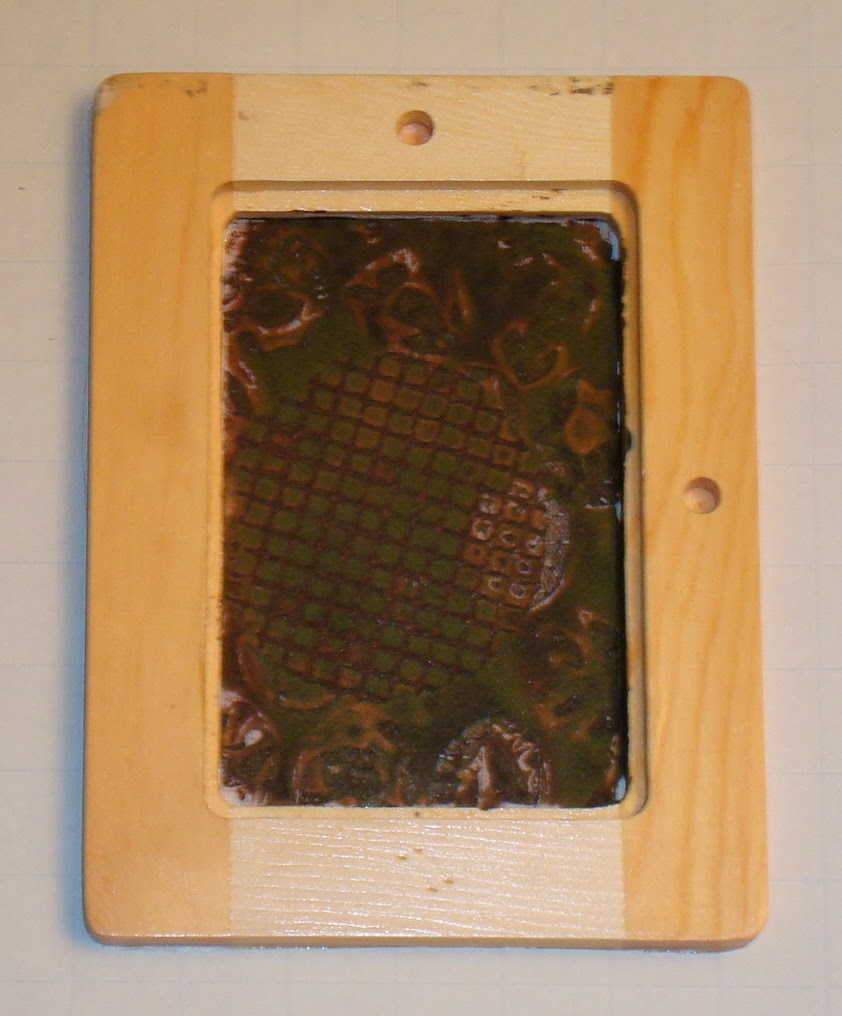
Here's another screen made from a one dollar paint-it-yourself picture frame from the hobby store.  One side has a recess for the photo and backing.  The holes are for a little peg that holds the fame upright on a desk.  This side, of course, had to become the up side of the printing screen while the front of the photo frame became the back  Clear?  I hope so!  Look, ma, no tape!  For this one, I glued it perfectly and just used scissors to trim the excess.  I love it - although it is one of my smaller screens. I never wash it.
Another one of my double-woven deconstructed screen prints, say that ten times fast!  This is a detail, I love the way the weave adds texture to the color of the dye.  I put a tape measure on the cloth and placed a commercial cotton next to it.  It's a sample from a eco/contact print that just happened to be handy.  Looking at the thread counts - in my handwoven, it's about 16 ends per inch compared to at least 200 for quilter's cotton. It's a difference in resolution, a lot like reducing the pixels in a photo blurs the photo somewhat.

Too bad I didn't print from that screen on some commercial cotton for a better comparison but at the time, I had no idea I would be rambling so much about the process here on the Fire blog. Since this is deconstructed screen printing, that screen is exhausted and no way I can reproduce the exact image again unless I print the photo image onto fabric with my Epson printer.  Now that would make an interesting composition - combining the handwoven with the digital print.

The double woven cloth is still pinned on the print board.  I have yet to dye the other side - there's a piece of plastic between the two layers - so it's still virgin cloth on the reverse.  Waiting for inspiration on what will go with this.  That's my story and I'm sticking to it.  But the digital print / handwoven mash-up is sounding like a good way to go.  I may even do some selective unweaving of the cloth to go with the deconstructed printing.  Deconstructed Deconstruction would be a perfect title.  


Here's the screen before printing.  
And several screens I've made that have only minimal taping. 
Thanks for following along this month.  Hope you'll try making a screen for deconstructed screen printing.

Diane - yarngoddess